
Best Budget eSIM Providers 2026: Cheapest Plans Compared
Finding affordable mobile data while traveling used to mean hunting for local SIM cards at airport kiosks or paying outrageous roaming fees. Budget eSIM providers have changed that completely. In 2026, you can get connected in 190+ countries for as little as $1 per gigabyte, all without swapping a physical card. This guide breaks down the cheapest eSIM options available right now, compares real pricing across providers, and helps you pick the right plan for your trip.
📺 Video Guide
What Makes an eSIM Provider “Budget-Friendly”?
Price per gigabyte is the most useful metric when comparing eSIM providers. A plan advertising “10GB for $25” sounds reasonable until you realize another provider sells the same amount for $12. But raw price isn’t everything. You also need to consider coverage quality, throttling policies, customer support responsiveness, and whether the plan includes extras like hotspot tethering or free messaging apps.
The GSMA, the organization that sets global mobile standards, reports that eSIM adoption grew 300% between 2022 and 2025. That surge in competition has driven prices down significantly. Providers that charged $8-10 per GB two years ago now offer the same data for $2-3. Budget travelers benefit the most from this price war.
💡 Pro Tip
Always compare per-GB cost, not total plan price. A $5 plan with 1GB ($5/GB) is worse value than a $15 plan with 10GB ($1.50/GB). Use comparison sites like eSIMDB to sort providers by destination and price.
Top 7 Budget eSIM Providers for 2026
After testing dozens of providers across multiple countries, these seven consistently deliver the best value for budget-conscious travelers.
1. Saily: Best Overall Budget Pick
Built by the team behind NordVPN, Saily has quickly become one of the most popular budget eSIM apps. Plans start at $3.99 for 1GB, and their 10GB global plan runs about $19.99 for 30 days. That works out to roughly $2/GB, which is hard to beat for 200+ country coverage.
What sets Saily apart from cheaper competitors is reliability. They maintain a 4.7/5 rating on Trustpilot with over 15,000 reviews. The app also includes a built-in VPN for public WiFi security, which saves you the cost of a separate VPN subscription while traveling.
The one drawback: activation can take up to a few hours in some regions. If you need instant connectivity the moment you land, activate your plan a day before departure while still on WiFi.
2. Jetpac: Cheapest Entry Price
Jetpac runs an aggressive introductory offer: $1 for 1GB for new users. Even at regular pricing, their per-GB cost hovers around $2.33 for larger plans (15GB for $35). They cover nearly 100 countries and support 5G in the USA across AT&T, Verizon, and T-Mobile networks.
Jetpac also offers something unusual for budget providers: free access to messaging apps like WhatsApp and Telegram even after your high-speed data runs out. For backpackers who mostly need messaging and maps, this extends the value of smaller plans considerably. Their Trustpilot score of 4.8/5 backs up the quality.
3. Airalo: Largest Provider Network
Airalo is the biggest name in the eSIM space, covering 200+ countries with both local and regional plans. Their pricing starts around $4.50 for 1GB, which isn’t the absolute cheapest, but their regional plans offer excellent value. A 5GB Europe plan covering 39 countries costs about $18, working out to $3.60/GB for multi-country coverage.
Where Airalo shines for budget travelers is variety. They partner with local carriers in each country, so you get better network coverage than providers who route everything through a single wholesale carrier. The app is also the most polished in the category, according to reviews on the Apple App Store, making activation straightforward even for first-time eSIM users.
4. Nomad: Best for Short Trips
Nomad targets the weekend-trip and one-week traveler segment with plans starting at $4 for 1GB. Their 10GB/30-day Europe plan costs $18 ($1.80/GB), making them one of the cheapest options for European travel specifically. They also offer a free trial so you can test connectivity before committing money.
The free trial is genuinely useful. You get a small amount of data to test signal strength and speed at your destination. If it works well, you top up. If not, you haven’t spent anything. Not many providers offer this, and for budget travelers who worry about wasting money on a plan that doesn’t work, it removes that risk.
✓ Key Benefits of Budget eSIM Providers
- ✓ No physical SIM card swapping or losing your home SIM
- ✓ Plans from $1-5 per GB compared to $10-20/GB for roaming
- ✓ Instant activation via QR code or app download
- ✓ Switch between plans and providers without visiting a store
- ✓ Keep your home number active on your physical SIM while using eSIM for data
5. Roamless: Best Pay-As-You-Go Option
Roamless takes a different approach. Instead of fixed data bundles, you load credit and pay per MB as you use it. Their 10GB equivalent costs about $18.95 with no throttling, and they cover 200+ countries including harder-to-reach destinations like Cuba. Data credit doesn’t expire, so you can buy once and use across multiple trips.
This pay-as-you-go model works well if you’re not sure how much data you’ll use. Heavy users might find fixed plans cheaper, but light users (checking email, maps, and occasional browsing) can save significantly by only paying for what they actually consume. Use promo code RUNAWAY20 for 20% off your first purchase.
6. Simbye: Cheapest Starting Price
Simbye offers some of the lowest absolute prices in the market. Their 1GB/7-day plans start at $3.00 for popular destinations like Japan, USA, Turkey, and Thailand. They also offer a free 100MB trial for new users, letting you test the service before spending anything. For 5GB/30-day plans, pricing starts at $12 for most countries and $15 for Europe.
Simbye is a newer entrant compared to Airalo or Saily, which means fewer user reviews. But their pricing structure is transparent, and the free trial shows confidence in their network quality. If you’re traveling to a single country and want the absolute cheapest option, Simbye is worth checking.
7. Holafly: Best Unlimited Budget Option
Holafly sits at the higher end of “budget” but earns a spot here because of their unlimited data plans. Starting around $19 for 5 days, the per-day cost drops the longer your trip. A 30-day unlimited plan runs about $64.90, which sounds expensive until you compare it to buying 20-30GB from other providers.
For heavy data users who stream video, work remotely, or share hotspot with travel companions, Holafly’s unlimited plans can actually be the cheapest overall. The FCC notes that international roaming charges from US carriers average $10/day. Even Holafly’s pricier plans beat that rate while giving you unlimited data.
Price Comparison: Budget eSIM Providers at a Glance
Here’s how these seven providers stack up on price for a typical 10GB/30-day plan:
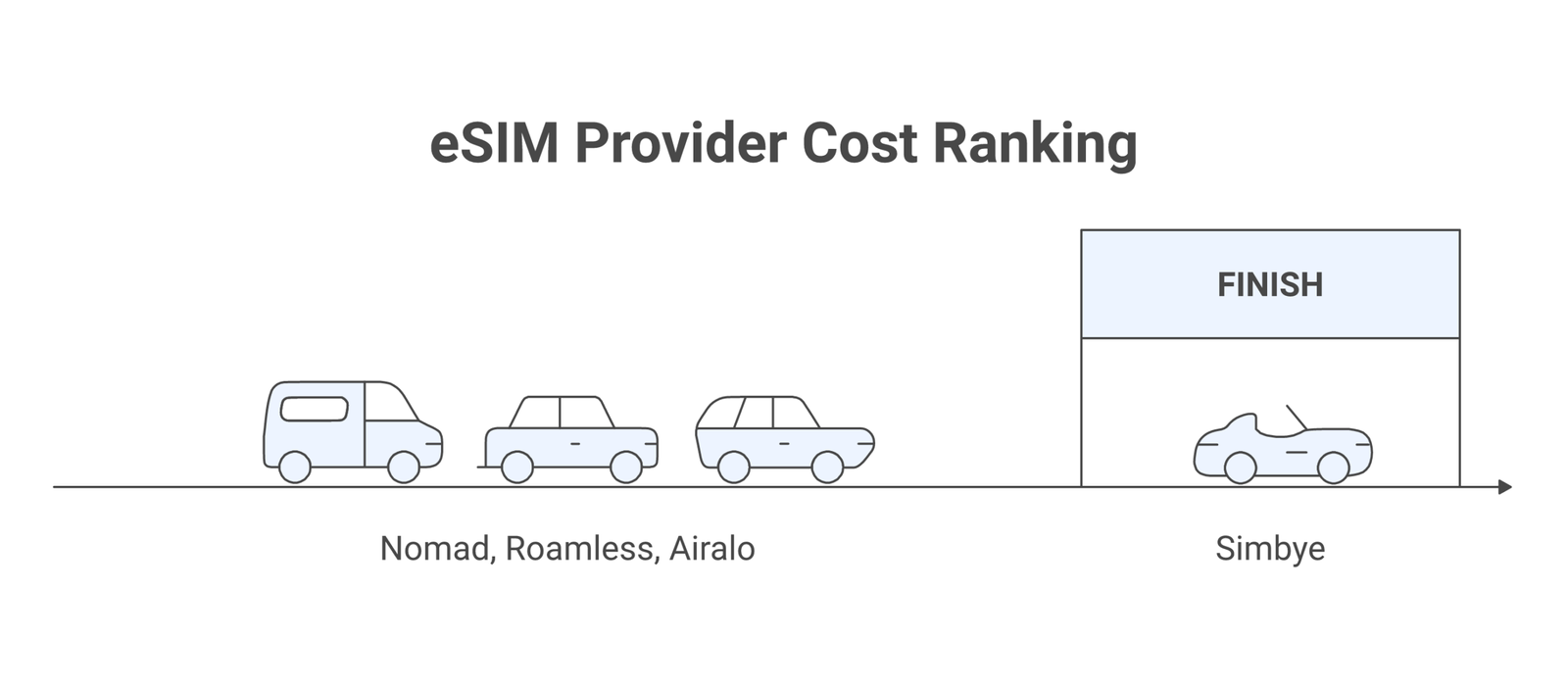
- Simbye: ~$12-15 ($1.20-1.50/GB)
- Nomad: ~$18 ($1.80/GB)
- Roamless: ~$18.95 ($1.90/GB)
- Saily: ~$19.99 ($2.00/GB)
- Airalo: ~$19.50 ($1.95/GB)
- Jetpac: ~$23 ($2.30/GB)
- Holafly: ~$39.90 ($3.99/GB, but unlimited available)
Prices vary by destination. European plans tend to be cheaper than global ones, and single-country plans beat regional coverage on per-GB cost. Always check pricing for your specific destination before buying.
How to Choose the Right Budget eSIM for Your Trip
The cheapest provider isn’t always the best choice. Your pick should depend on four factors: destination, trip length, data usage, and whether you need extras like calls or hotspot.
Single country, short trip (under 7 days): Go with Simbye or Jetpac. Their small plans ($1-5) are perfect when you only need basic data for navigation and messaging. There’s no point paying for 10GB when you’ll use 2GB in a long weekend.
Multi-country, 1-2 weeks: Nomad or Airalo’s regional plans give you coverage across multiple countries on one plan. Buying separate country plans for each stop on a Euro trip gets expensive fast.
Long-term travel (1+ months): Saily or Roamless. Saily’s monthly plans offer consistent pricing, while Roamless’s pay-as-you-go model works for unpredictable usage patterns. The International Telecommunication Union reports that average mobile data consumption for travelers is 5-8GB per month, so plan accordingly.
Heavy data users: Holafly unlimited. If you work remotely, stream content, or share hotspot with a partner, unlimited removes the stress of watching your data counter. At $2.16/day on a 30-day plan, it’s cheaper than most hotel WiFi upgrades.
Setting Up a Budget eSIM: Step by Step
Most budget eSIM providers follow the same activation process. Here’s what to expect:
Step 1: Check device compatibility. Your phone needs eSIM support. Most iPhones from iPhone XS onward and Samsung Galaxy S20+ onward support eSIM. The Apple support page has a complete list of compatible iPhone models. Google Pixels from Pixel 3a onward also work.
Step 2: Download the provider’s app and create an account. Most are available on both the App Store and Google Play.
Step 3: Purchase your plan and scan the QR code or use the direct install option in the app. On iPhone, go to Settings > Cellular > Add eSIM. On Android, it’s Settings > Network & Internet > SIMs > Add eSIM.
Step 4: Label your eSIM (something like “Travel Data”) so you don’t confuse it with your primary line.
Step 5: Set the eSIM as your data line when you arrive at your destination. Keep your primary SIM for calls and texts from home.
📝 Important Note
Install your eSIM before leaving home while you still have WiFi. Some providers take up to a few hours to activate, and you don’t want to be stuck at a foreign airport with no data and no way to complete the setup.
Hidden Costs to Watch For
Budget eSIM plans sometimes come with catches that inflate the real cost. Watch out for these:
Throttling after a cap: Some “unlimited” plans throttle to 128kbps or 256kbps after a daily high-speed cap. That’s barely enough for loading a webpage. Check the fine print for daily limits. Saily’s unlimited plan, for example, throttles after 1GB/day of high-speed data.
No hotspot/tethering: Several budget providers block tethering. If you planned to share your phone’s data with a laptop or travel partner, confirm hotspot is allowed before buying. The FTC consumer guide explains your rights regarding data usage.
Short validity periods: A $3 plan for 1GB sounds cheap, but if it expires in 3 days, you might need to buy multiple plans during a 10-day trip. Calculate total cost for your full trip duration, not just the per-plan price.
Data-only plans: Most budget eSIMs are data-only. You won’t get a phone number for making calls. If you need voice calls, use WiFi calling through your primary number or apps like WhatsApp and Telegram.
Budget eSIM vs. Other Cheap Connectivity Options
eSIMs aren’t the only way to get cheap data abroad. Here’s how they compare to alternatives:
Local SIM cards are sometimes cheaper per GB, especially in countries like Thailand or India where tourist SIMs cost $5-10 for large data bundles. But you lose your home number (unless your phone supports dual SIM), need to find a shop, bring your passport for registration in many countries, and buy a new SIM at each destination. According to the World Bank’s digital development data, 60+ countries now require ID registration for SIM purchases.
Pocket WiFi rentals cost $5-15/day and give you a separate device. They offer stronger signal than phone hotspot in some cases, but you’re carrying another gadget, charging another battery, and usually paying more per day than an eSIM costs. Our eSIM vs Pocket WiFi comparison covers this in detail.
Carrier roaming packages from AT&T, Verizon, or T-Mobile typically run $6-12/day for a fixed data allowance. Over a two-week trip, that’s $84-168 compared to $12-25 for an eSIM with similar data. The math isn’t close. Our guide on eSIM vs roaming costs shows the exact savings.
Free WiFi only is the ultimate budget option, but it limits you to cafes and hotels. For navigation, ride-hailing, and real-time translation, you need mobile data. A $3-5 eSIM plan is worth the convenience for most travelers.
Tips to Save Even More on eSIM Data
Even with budget providers, a few habits can stretch your data further:
Download offline maps through Google Maps or Maps.me before your trip. Navigation is one of the biggest data consumers while traveling, and offline maps eliminate that usage entirely.
Disable automatic app updates and cloud photo uploads. A single iOS update can consume several gigabytes. Go to Settings and switch app updates to WiFi-only. Do the same for iCloud Photos, Google Photos, and any cloud backup services.
Use WiFi whenever available and save your eSIM data for when you actually need mobile connectivity. Most hotels, cafes, and airports offer free WiFi. Our data management guide has more detailed strategies.
Look for promo codes before purchasing. Many providers offer first-time discounts: Jetpac’s $1/1GB deal, Nomad’s free trial, and Roamless’s RUNAWAY20 code for 20% off. Travel blogs and eSIM comparison sites frequently list active coupon codes. Checking r/esim on Reddit often surfaces deals that aren’t advertised on provider websites.
⚠️ Disclaimer
Prices and plans mentioned in this article are accurate as of March 2026 and may change. eSIM provider pricing varies by destination, plan duration, and ongoing promotions. Always verify current pricing directly on the provider’s website before purchasing. We may earn a commission from affiliate links at no extra cost to you.
Frequently Asked Questions
Jetpac offers the lowest entry price at $1 for 1GB for new users. For ongoing value, Simbye and Nomad offer the best per-GB rates, with 10GB plans starting at $12-18. The cheapest option depends on your specific destination and data needs.
Can I use a budget eSIM with my existing phone number?Yes. Most modern smartphones support dual SIM (physical + eSIM). You keep your primary number active on your physical SIM for calls and texts, and use the eSIM purely for data. Both run simultaneously, so you won’t miss calls or messages from home.
Are budget eSIM providers reliable or do they have poor network quality?Budget providers use the same underlying carrier networks as premium ones. Saily, Jetpac, and Airalo all connect through major local carriers in each country. The difference between budget and premium providers is usually plan flexibility and customer support, not actual network speed.
How much data do I need for a typical one-week trip?Most travelers use 3-5GB per week with moderate usage (maps, messaging, social media, light browsing). If you download offline maps and use hotel WiFi for heavy tasks, you can get by on 1-2GB. Video streaming and remote work push usage to 10GB+ per week.
Can I switch between budget eSIM providers during a trip?Yes. Most phones can store multiple eSIM profiles (iPhone supports 8+, many Android phones support 5+). You can install eSIMs from different providers before your trip and activate whichever one offers the best coverage at each destination. Only one eSIM data plan can be active at a time, but switching takes seconds. Check our guide on using multiple eSIMs on one phone for detailed instructions.