
eSIM for Dubai and UAE Travel in 2026
Using an eSIM for Dubai and UAE travel is usually the fastest way to get data working as soon as you land. You can install the plan before departure, avoid airport kiosk queues, and switch on mobile data after arrival without swapping a plastic SIM card. For most travelers, that means faster setup, easier top-ups, and a simpler backup plan if hotel Wi-Fi is weak.
Dubai is one of the easiest places to travel with an eSIM-ready phone, but there are a few details that matter. Your device must be unlocked and compatible, local network partners differ by provider, and plan value depends on whether you need maps, ride-hailing, hotspot use, or heavier data for remote work. The GSMA eSIM overview, Apple’s eSIM support page, and Google’s Pixel eSIM guide are good starting points if you want to confirm device support before buying.
📺 Video Guide
Why travelers use an eSIM in Dubai
The main advantage is convenience. Instead of hunting for a shop after landing at Dubai Airports, you can scan a QR code at home, keep your primary SIM active, and start using local data when the plane touches down. That is especially useful for booking a taxi, opening hotel check-in emails, or using navigation on the way from the airport.
An eSIM also works well for short city breaks, stopovers, and business trips because you can buy only the data you need. If your trip includes Abu Dhabi, Sharjah, or a wider UAE itinerary, many plans cover the whole country through partner networks rather than limiting you to a single city. Travelers who already liked our breakdown of the best eSIMs for video calls and streaming will find the same pattern here: the right plan depends less on branding and more on coverage, fair-use rules, and how much data you actually burn.
✓ Key benefits
- ✓ Install before departure and activate on arrival
- ✓ Keep your regular number on the physical SIM if your phone supports dual SIM
- ✓ Avoid expensive roaming passes from your home carrier
- ✓ Top up data in-app instead of visiting a local store
Coverage and networks across the UAE
Most travel eSIM providers in the UAE rely on one of the country’s main operators, typically e& or du. Both have strong urban coverage in Dubai and Abu Dhabi, and both advertise broad 5G availability in populated areas. For official telecom information, check the UAE Telecommunications and Digital Government Regulatory Authority. If you are heading into desert areas, marinas, or long highway routes, your experience will depend on your provider’s roaming agreement and device radio support, not just the app’s marketing copy.
For typical travel use inside Dubai, coverage is rarely the problem. Data policy is. Some plans advertise “unlimited” service but reduce speed after a daily threshold. Others include hotspot sharing, while some restrict tethering. If you plan to work remotely from cafés, hotels, or coworking spaces, compare plan details carefully. Travelers doing heavier work should also read our guide on eSIMs for WhatsApp and internet-based calling abroad and our troubleshooting article on common eSIM issues and fixes before they fly.
💡 Pro tip
If your phone supports a physical SIM plus eSIM, keep your home number active for banking texts and use the UAE eSIM only for data. It is the least messy setup for most travelers.
How much data do you need for Dubai and UAE travel
A light traveler who mostly uses Google Maps, messaging, email, and ride-hailing can often get through a 4 to 7 day trip with 3GB to 5GB. A heavier user who uploads photos, uses cloud backups, streams video in the hotel, or runs hotspot sessions for a laptop may want 10GB or more. The exact number depends on habits, but the rough pattern is simple: navigation and chat are cheap, video is not.
Check whether your hotel, apartment, or conference venue has reliable Wi-Fi. The UAE has solid infrastructure, and hotel Wi-Fi is often good enough for evening use. That lets many travelers buy a smaller data package and top up only if needed. If you want a quick way to judge plan size, review Google’s offline maps documentation, WhatsApp’s support resources, and your cloud photo settings before departure.
How to choose the best UAE eSIM plan
Start with trip length. For a weekend in Dubai, a 1GB or 3GB plan may be enough if you stay disciplined. For a week-long trip that includes work, navigation, and frequent uploads, 5GB to 10GB is the safer buy. Then check whether the plan is UAE-only or regional. A regional Middle East option can be useful if you are connecting onward through other countries, but it is often more expensive than a UAE-specific plan.
Next, check these four details carefully: supported network, validity window, hotspot permission, and top-up policy. Those four tell you more than most “best provider” lists. You should also confirm that your device supports eSIM on the exact model sold in your market. Apple lists supported models on its iPhone eSIM compatibility page, Samsung publishes regional support details on its eSIM help center, and Google documents Pixel setup at its official support page.
📝 Important note
Do not buy a plan based only on the word “unlimited.” Read the fair-use rule, because reduced speed can make hotspot work or video streaming frustrating fast.
How to set up an eSIM before landing in Dubai
The cleanest approach is to install the eSIM one day before travel while you still have reliable home internet. Buy the plan through the provider app or website, scan the QR code, label the line clearly, and keep it switched off for mobile data until arrival if the provider recommends delayed activation. Most providers give a short setup checklist, but the flow is basically the same on iPhone, Pixel, and recent Samsung phones.
If you need a refresher on the phone side of the process, our guide on deleting and reinstalling an eSIM covers one of the most common recovery tasks for travelers. You can also check Apple’s Add eSIM on iPhone instructions and Google’s SIM manager help page if your menus look slightly different.
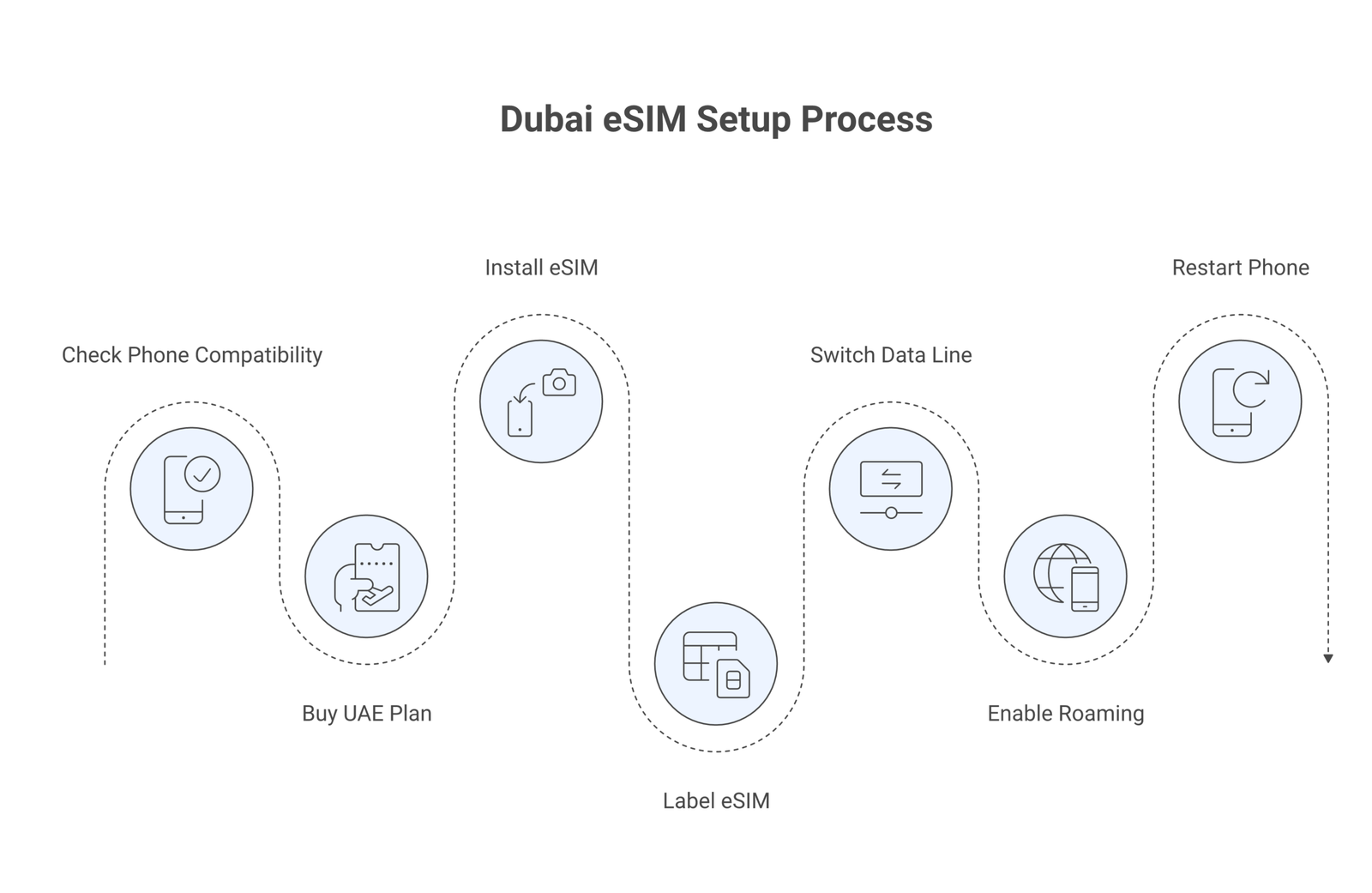
Step-by-step setup checklist
Here is the setup flow that causes the fewest surprises:
1. Confirm your phone is unlocked and eSIM-compatible.
2. Buy the UAE plan from a provider with clear network details.
3. Install the eSIM while connected to stable Wi-Fi.
4. Label the line “UAE Data” or something equally obvious.
5. Set that line as your mobile data line after landing.
6. Turn data roaming on only if your provider says it is required for partner-network access.
7. Restart the phone if data does not connect within a few minutes.
That last step sounds boring, but it solves a lot of first-use issues. If the plan still does not connect, check the APN instructions in the provider app, confirm the line is enabled, and make sure your home carrier line is not still selected for data.
What to expect with calls, texting, and apps in the UAE
Most travel eSIM plans for Dubai are data-only. That means you usually will not get a local UAE phone number, traditional SMS allowance, or local voice minutes. For many travelers that is fine, because maps, ride-hailing, email, WhatsApp messaging, and web browsing cover most of the trip. It matters more if you rely on SMS two-factor authentication or need voice calling for local reservations.
The UAE has had app-specific calling restrictions and service changes over time, so check current rules before assuming every voice or video feature will work the same way it does at home. The safest move is to verify current guidance through the TDRA, your eSIM provider, and your hotel or employer if business calling matters. If you mainly need messages, navigation, browser access, and occasional hotspot use, a standard data eSIM is still the simplest option.
⚠️ Disclaimer
Network partnerships, app behavior, pricing, and telecom restrictions can change. Check your provider’s latest UAE terms and official guidance from local authorities before travel. This article reflects information reviewed in April 2026.
Is a local SIM card ever better than an eSIM in the UAE
Sometimes, yes. A local SIM can make sense if you need a local number, expect very heavy data use over several weeks, or prefer buying directly from a national operator. But for most short and medium trips, a travel eSIM wins on convenience. You can buy it before you fly, compare prices calmly, and avoid setup friction when you are tired and jet-lagged.
The trade-off is simple. eSIM is easier. Local SIM may be cheaper or more flexible for longer stays. If you are deciding between those two paths, our guide on eSIM versus roaming cost comparison is a good companion read, and the same logic applies in the UAE: know your data habits first, then compare total trip cost instead of headline price.
Best use cases for a Dubai travel eSIM
An eSIM for Dubai and UAE travel makes the most sense for four types of travelers: short-stay tourists, business travelers, digital nomads who need a backup data line, and multi-country travelers connecting through the Gulf. In all four cases, the big win is speed. You stay connected without hunting for paperwork, waiting in a queue, or swapping out the SIM that already holds your primary number.
It is also a good fit for travelers who like redundancy. If hotel Wi-Fi goes sideways, an eSIM gives you an instant fallback. If your main line is expensive abroad, the UAE eSIM becomes your data line while the home line quietly handles incoming texts. That setup is boring in the best possible way. It just works.
Frequently asked questions
Usually yes, if the eSIM is installed correctly, your phone is unlocked, and the provider has a UAE roaming partner. Some plans require you to enable data roaming for partner-network access.
Can I keep my regular number while using a UAE eSIM?Yes, on phones that support dual SIM or physical SIM plus eSIM. Many travelers keep their home line for texts and use the UAE eSIM for data only.
How much data should I buy for a week in Dubai?For light use, 3GB to 5GB is often enough. If you stream, hotspot, upload media, or work remotely, 10GB is the safer starting point.
Do Dubai travel eSIMs include calls and SMS?Most travel eSIMs are data-only. Check the provider details carefully if you need a local number or traditional voice service.
Is eSIM better than buying a SIM card at Dubai airport?For most travelers, yes. It saves time and lets you compare options before you fly. A local SIM can still make sense for longer stays or if you need a local number.