
eSIM for Spain: Traveler’s Complete Guide 2026
Why You Need an eSIM for Spain
Getting an eSIM for Spain saves you the hassle of hunting for a SIM card shop when you land in Barcelona or Madrid. Instead of wasting your first hour abroad standing in a phone store queue, you activate your data plan before the flight and you’re online the moment wheels touch tarmac. That alone makes it worth considering.
Spain runs on three major mobile networks: Movistar (owned by Telefonica), Vodafone Spain, and Orange Spain. All three offer solid 4G/LTE coverage across the mainland, the Balearic Islands, and the Canaries. Most eSIM providers piggyback on one of these networks, so you get the same speeds and coverage a local would.
If you’ve been relying on hotel Wi-Fi or cafe hotspots to navigate Google Maps, translate menus, or book last-minute tickets, an eSIM changes the game. You get your own data connection everywhere, no passwords required. And if you’re already familiar with what an eSIM is and how it works, you can skip ahead to the provider comparison below.
📺 Video Guide
Best eSIM providers for Spain in 2026
I’ve tested and compared the main eSIM providers that work well in Spain. Here’s what each one brings to the table.
Airalo is the one most travelers default to, and for good reason. They offer Spain-specific plans starting around $5 for 1GB (7 days) up to $26 for 10GB (30 days). Setup takes about two minutes through their app, and their Spain eSIM page walks you through it. Coverage connects through local carriers with reliable 4G across cities and tourist areas.
Saily (made by the team behind NordVPN) has become a strong budget pick. Plans start at $3.99 for 1GB, and they support 5G in areas where it’s available. The app handles activation automatically when you arrive, which is one less thing to think about. Saily’s Spain plans are data-only, so you’ll use WhatsApp or FaceTime for calls.
Holafly is the unlimited data option. If you don’t want to think about data caps at all, Holafly offers unlimited plans starting around $19 for 5 days. They connect through Movistar’s network, which gives you coverage even in smaller towns. The trade-off: you can’t use personal hotspot on unlimited plans, and speeds may slow during peak hours.
Nomad offers competitively priced regional plans. Their Europe eSIM covers Spain plus 30+ other European countries, which makes them ideal if your trip includes stops in France or Portugal. Plans range from $8 for 1GB to $44 for 10GB (30 days) on the Europe plan.
Yesim stands out for multi-country flexibility. At around €20 for 10GB (30 days), they offer solid value with premium network access. If you’re planning a multi-country European trip, Yesim covers 200+ countries under one plan.
✓ Quick comparison at a glance
- ✓ Cheapest entry: Saily at $3.99/1GB
- ✓ Best unlimited: Holafly from $19/5 days
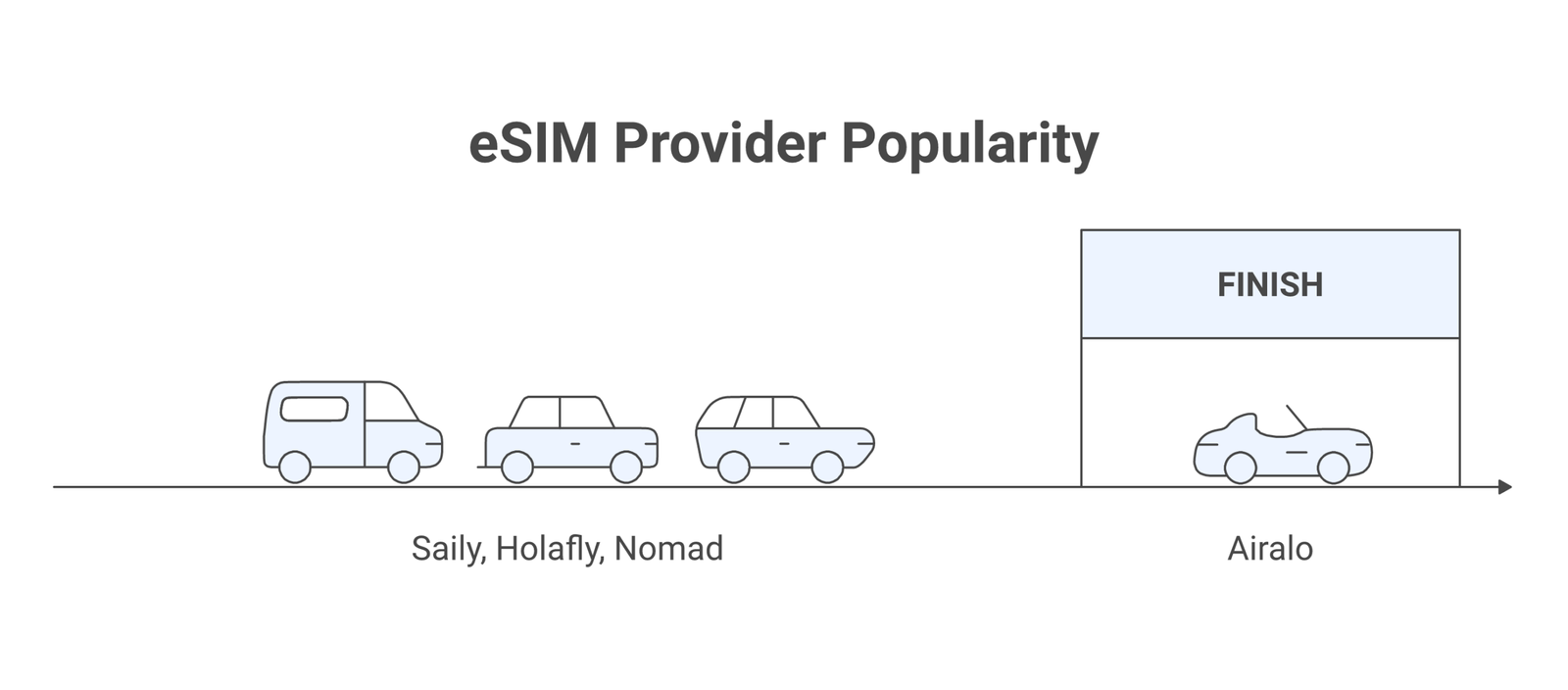
- ✓ Most popular: Airalo with 10M+ downloads
- ✓ Best for multi-country: Nomad or Yesim Europe plans
- ✓ 5G support: Saily and select Airalo plans
How to set up your eSIM for Spain
Setting up an eSIM takes five minutes at most. Here’s the process, regardless of which provider you pick:
1. Check your phone supports eSIM. Most iPhones from the XS (2018) onward support eSIM, as do Samsung Galaxy S20+, Google Pixel 3+, and many other modern Android phones. The GSMA, the industry body behind eSIM standards, maintains the official spec. If you’re unsure about your device, check our eSIM compatible phones list.
2. Buy your plan before you leave. Download your chosen provider’s app (Airalo, Saily, or others), select a Spain or Europe plan, and complete the purchase. You’ll receive a QR code by email or in the app.
3. Scan the QR code. On iPhone, go to Settings > Cellular > Add eSIM > Use QR Code. On Android, it’s Settings > Network & Internet > SIMs > Add eSIM. You need Wi-Fi or mobile data for this step, so do it at home or your hotel before departure.
4. Label your lines. Your phone will show two lines: your regular SIM and the new eSIM. Label them something obvious like “Home” and “Spain Travel” so you don’t accidentally use the wrong one for data.
5. Activate on arrival. Some providers activate automatically when they detect a Spanish network. Others need you to toggle the eSIM line on manually. Either way, turn off data roaming on your home SIM to avoid surprise charges. If you’ve never done this before, our iPhone eSIM activation guide walks through every screen.
💡 Pro tip
Install the eSIM a day or two before your flight, but don’t activate it yet. That way, if anything goes wrong with the QR code, you still have time to contact support while you’re on your home Wi-Fi. Activating early doesn’t start your data plan. Most providers only begin counting days once you connect to a network in Spain.
Coverage across Spain: what to expect
Spain’s mobile coverage is among the best in Europe. According to Ookla’s Speedtest Global Index, Spain consistently ranks in the top 20 for mobile speeds worldwide. In cities like Madrid, Barcelona, Valencia, and Seville, you’ll get fast 4G/LTE almost everywhere, with 5G rolling out across major urban centers.
Tourist hotspots are well covered. The Costa del Sol, Costa Brava, Mallorca, Ibiza, Tenerife, and Gran Canaria all have strong signal from multiple carriers. You won’t have trouble using maps, uploading photos, or streaming in these areas.
Where coverage gets patchy is deep rural Spain. If you’re driving through inland Extremadura, parts of Aragon, or hiking the Camino de Santiago, expect occasional dead zones. The CNMC (Spain’s telecom regulator) has been pushing carriers to improve rural coverage, but gaps remain in mountainous and sparsely populated areas.
My advice: download offline maps for Google Maps or Maps.me before you head into rural territory. The eSIM will reconnect as soon as you’re back in range, but having offline navigation prevents you from getting stuck at a crossroads with no signal.
How much data do you actually need in Spain?
This depends entirely on how you use your phone while traveling. Here are some rough numbers to help you pick the right plan:
Light user (1-3GB for a week): You use Wi-Fi at hotels and restaurants for heavy stuff. Mobile data is mainly for maps, messaging, and the occasional search. This is enough for most sightseeing trips.
Moderate user (5-7GB for a week): You browse social media on the go, post photos to Instagram, use ride-hailing apps like Cabify (Spain’s answer to Uber), and stream some music. This covers most travelers.
Heavy user (10GB+ for a week): You work remotely, join video calls, stream Netflix, or use your phone as a hotspot for a laptop. Go for 10GB minimum, or consider Holafly’s unlimited plans.
One thing to watch: video calls eat data fast. A 30-minute WhatsApp video call uses about 250MB. If you’re calling family back home daily, budget for heavier usage or stick to voice-only calls, which use about 15MB for the same duration. For a deeper look at managing your data abroad, check our eSIM vs roaming cost comparison.
📝 About EU roaming rules
If you have a European SIM card, EU “Roam Like at Home” regulations (under EU Regulation 2022/612) let you use your domestic plan in Spain at no extra cost. But this doesn’t apply to UK travelers post-Brexit, US visitors, or anyone with a non-EU number. For those travelers, an eSIM is the most cost-effective option.
eSIM vs local Spanish SIM card
You can still buy a physical prepaid SIM at Spanish airports and phone shops. Movistar, Vodafone, and Orange all sell tourist SIM cards. A typical prepaid SIM runs about €10-15 for 10-15GB and includes some call minutes.
So why would you pick an eSIM instead? A few reasons. First, you avoid the airport SIM shop, which is often overpriced and crowded. Second, you keep your home SIM active for calls and texts (dual SIM setup). Third, you can buy and install before you travel, so you land with data ready. And fourth, no tiny SIM tray tool needed, and no risk of losing the little card in the back of a taxi.
The main downside of eSIM: most plans are data-only. If you need a Spanish phone number for local calls (booking restaurants, contacting Airbnb hosts), a physical SIM with a number might be more practical. That said, WhatsApp handles 90% of communication in Spain anyway. If you want to understand the full picture, we’ve compared eSIM vs physical SIM in detail.
Staying connected in popular Spanish destinations
Barcelona: Excellent coverage across the city, including inside the metro (Movistar and Vodafone both have underground coverage). Free public Wi-Fi exists at some beaches and parks, but it’s slow and unreliable. Your eSIM will work much better for real-time navigation through the Gothic Quarter or ordering tickets to La Sagrada Familia online (which you should, since walk-up tickets sell out).
Madrid: Full 4G/5G coverage. The metro has Wi-Fi through Gowex at most stations. Data works well throughout the city, from the Prado Museum area to the narrow streets of La Latina. Useful for checking opening hours, avoiding tourist traps, or finding the best tapas bar nearby.
The Islands (Mallorca, Ibiza, Tenerife, Canaries): Coverage is strong in towns and resort areas. Remote hiking trails on Tenerife’s Teide volcano or Mallorca’s Serra de Tramuntana can lose signal at higher elevations. Download offline maps if you plan to hike.
Andalusia (Seville, Granada, Malaga): Good coverage throughout. The Spain Tourism Board recommends booking Alhambra tickets weeks ahead, and having data to check availability from your phone saves time. Coverage holds up along the Costa del Sol’s beach towns.
Camino de Santiago: This is the one route where you’ll hit dead zones. The French Way (Camino Frances) passes through small villages in Navarra, La Rioja, and Galicia where coverage drops. Download your stage maps offline and don’t rely solely on your phone for navigation.
Money-saving tips for eSIM in Spain
A few ways to get more out of your eSIM plan without burning through data:
Use Wi-Fi for downloads. Update apps, download podcasts, and sync photos to cloud storage on hotel Wi-Fi. Save your eSIM data for on-the-go essentials.
Turn off auto-play videos. Instagram, Facebook, and TikTok all auto-play videos as you scroll. That chews through data fast. Switch these apps to Wi-Fi-only video playback in their settings.
Download offline content. Google Maps lets you download regions for offline use. Google Maps offline mode works for navigation without any data. Spotify and Netflix also let you download for offline playback.
Compare regional vs. country plans. If you’re only visiting Spain, a Spain-only plan usually costs less per GB than a Europe-wide plan. But if your trip includes a stop in Portugal or France, the regional plan becomes better value.
Top up rather than over-buy. Most eSIM providers let you buy additional data if you run out. Start with a smaller plan and add more if needed, rather than paying upfront for data you might not use.
⚠️ Disclaimer
Prices and plan details mentioned in this article reflect information available as of March 2026. eSIM providers frequently update their pricing and coverage. Always check the provider’s official website for current rates before purchasing.
Frequently asked questions
No. Unlike some countries that require ID registration for SIM cards, Spain doesn’t require tourists to register eSIMs purchased through international providers like Airalo or Saily. You buy, scan the QR code, and you’re connected.
Can I use my eSIM in the Canary Islands?Yes. The Canary Islands are part of Spain, so any Spain eSIM plan covers them. Coverage is strong in Las Palmas, Santa Cruz de Tenerife, and resort areas. Remote volcanic trails may have weaker signal.
Will my eSIM work for WhatsApp calls in Spain?Yes. eSIM data plans support all internet-based apps, including WhatsApp voice and video calls, FaceTime, Zoom, and Telegram. Voice calls use about 0.5MB per minute, and video calls use about 8MB per minute.
Can I share my eSIM data as a hotspot?It depends on the provider. Airalo and Saily allow hotspot/tethering on most plans. Holafly’s unlimited plans do not support hotspot. Check the provider’s terms before purchase if hotspot sharing matters for your trip.
What happens if I run out of eSIM data in Spain?You won’t be charged automatically. Most eSIM providers simply stop your data connection. You can then buy a top-up through the app, purchase a new plan, or connect to Wi-Fi. There are no overage fees with prepaid eSIM plans.
Is 5G available through eSIM in Spain?Some providers like Saily offer 5G access where available. Spain has 5G coverage in Madrid, Barcelona, Valencia, Seville, and other major cities. However, 4G/LTE is fast enough for virtually any tourist activity, so 5G is a nice bonus rather than a necessity.