
eSIM for Mexico: Complete Travel Guide 2026
An eSIM for Mexico is the easiest way to get data the moment you land, without hunting for a kiosk, swapping tiny plastic cards, or paying your home carrier’s roaming rates. If your phone is unlocked and eSIM-compatible, you can install a plan before departure, keep your regular number on your main SIM, and use Mexican data for maps, Uber, WhatsApp, banking, and work. That convenience matters in Mexico because arrival days move fast, airports get busy, and you usually need data before you need anything else.
📺 Video Guide
💡 Pro Tip
Install your Mexico eSIM at home on stable Wi Fi, but switch mobile data to that line only after landing. That gives you a calmer setup and avoids accidental roaming.
Why travelers choose an eSIM for Mexico
Mexico is a great case for eSIM. You may land in Mexico City, connect through Cancún, then spend part of the trip in Oaxaca, Tulum, Los Cabos, or Guadalajara. A digital plan lets you get online right away for airport pickups, hotel check in, and secure logins. According to GSMA guidance on eSIM technology, the whole point of eSIM is remote provisioning. You download a carrier profile instead of inserting a physical card. For travelers, that means less friction and fewer chances to lose your home SIM halfway through a trip.
Compatibility is the first gate. Apple explains the process in its official iPhone eSIM support article, Google does the same in the Pixel eSIM setup guide, and Samsung lists supported models in its Galaxy eSIM support page. If your phone supports eSIM but is carrier locked, that is where trips go sideways. The technology may work fine, but the device still will not accept a third party profile.
The other reason travelers prefer eSIM is flexibility. You can buy a Mexico only plan for a short vacation, a North America regional plan if you are crossing the border, or a broader Latin America option for multi stop travel. If you want a cheaper plan first, the site already has a roundup of best budget eSIM providers in 2026. That article is a good companion if price matters more than premium support.
✓ Key benefits
- ✓ You can install your plan before departure.
- ✓ You usually keep your regular SIM active for calls or one time codes.
- ✓ Top ups are easier than finding a physical store during a trip.
- ✓ Regional plans make side trips easier if Mexico is not your only stop.
How mobile coverage works in Mexico
Most travel eSIM brands do not run their own towers. They ride on local Mexican networks. In practice, that usually means one or more of the big operators, such as Telcel, AT&T Mexico, and Movistar Mexico. The exact partner varies by eSIM brand and sometimes by plan tier. That is why two travelers can buy “Mexico eSIM” plans at similar prices and still report different performance in the same city.
Coverage is usually solid in major cities, resort zones, and airports. It gets less predictable once you move into rural highways, mountain towns, islands, or remote beach areas. Mexico’s telecom regulator, the Instituto Federal de Telecomunicaciones, publishes consumer information on mobile services, and carrier sites remain the best place to check network details before buying. If your trip includes long bus rides, road travel, or work calls outside major cities, do not buy on price alone. Buy on network reputation and tethering rules.
This is also why “unlimited” needs a careful read. Some providers offer unlimited plans with fair use policies or reduced speed after a threshold. Others limit hotspot use or video quality. If constant streaming matters, compare that separately. We already broke down that angle in best eSIM for video calls and streaming, which helps if your Mexico trip includes work meetings or heavy uploads.
📝 Important Note
A Mexico eSIM with great speed in Mexico City can feel very different in a beach town or on a highway. Always check network partner details, hotspot terms, and top up options before you buy.
What to check before you buy
The best eSIM for Mexico depends on trip length, data habits, and whether you need tethering. A weekend city break is one thing. A three week trip across several states is another. Start with device compatibility, then move to plan type. The Apple guide for supported eSIM carriers and activation options is useful if you travel with an iPhone, while Google’s broader Pixel SIM and eSIM overview is the cleanest reference for Android travelers using Pixel devices.
Then look at the plan details that providers like to hide in smaller text. Is the plan data only, or does it include a local number? Does hotspot sharing work? Can you set the activation date in advance, or does the validity period begin right after installation? Does it cover only Mexico, or all of North America? That last one matters if you enter through the United States or continue to Canada. AT&T explains some of the broader setup logic in its eSIM setup resource, even though the plans themselves are different from travel eSIM providers.
You should also be realistic about data use. Navigation, maps, messaging, and occasional browsing rarely need huge plans. Social video, remote work, cloud backups, and tethering can chew through gigabytes fast. If you tend to underestimate usage, keep a usage monitor ready. Our guides on how to check eSIM data usage and eSIM data management tips for travelers are worth reading before departure.
Finally, check the human part of the trip. Are you traveling with kids, older relatives, or a group that will lean on your hotspot? Are you staying in one resort with strong Wi Fi, or moving constantly? If you are on a longer academic or work stay, it is smart to compare short trip plans with more stable options. The piece on eSIM for students studying abroad covers that longer-stay mindset well.
Mexico eSIM setup checklist
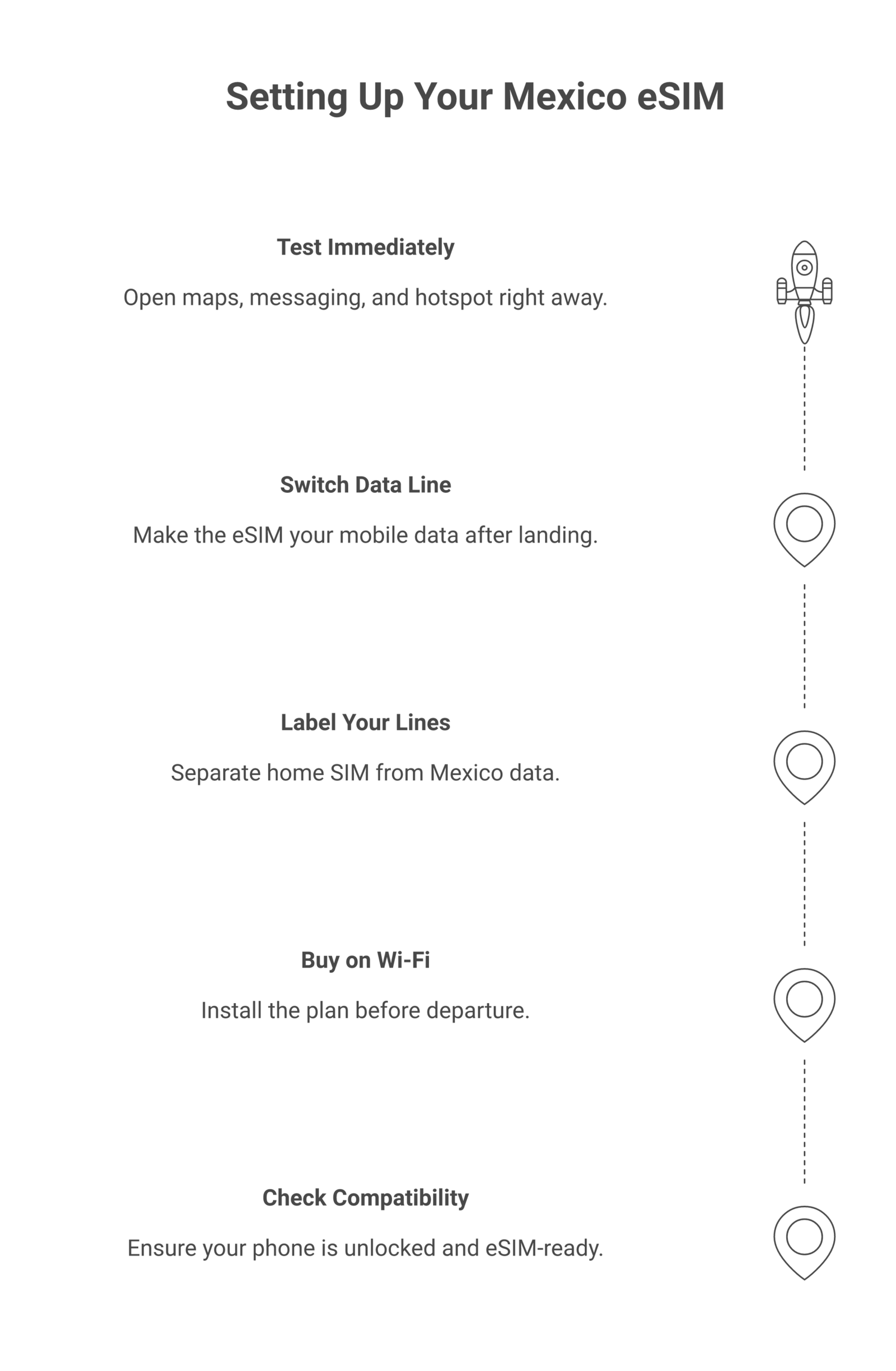
Setup is usually simple, but small mistakes can waste an hour at exactly the wrong time. This is the cleanest sequence.
- Confirm your phone is unlocked and eSIM-ready. Use the official Apple, Google, or Samsung support pages before you buy.
- Buy the plan on stable Wi Fi. Download the eSIM while you are still at home or in a hotel with reliable internet.
- Label your lines clearly. Name one line “Home” and the other “Mexico data” so you do not choose the wrong one later.
- Switch data roaming and primary data settings carefully. Keep your home line for calls if needed, but make the Mexico eSIM your mobile data line after landing.
- Test maps, messaging, and hotspot right away. Do not wait until you are in the back of a taxi with no signal.
If the provider gives you the choice between immediate activation and activation on first network connection, read that screen closely. Travelers often rush through it and accidentally start the validity clock a day early.
Which plan type makes sense for your trip
Most travelers can sort Mexico eSIM plans into four buckets. A short city break usually fits a small fixed data plan. A beach holiday with lots of photo uploads may need a mid-range plan. A work trip often needs stronger hotspot support and reliable renewals. A multi-country itinerary may be better with a regional plan than a Mexico-only one.
| Trip type | Typical plan | What matters most |
|---|---|---|
| 3 to 5 day city break | 1 GB to 3 GB fixed plan | Fast activation and fair price |
| 1 to 2 week vacation | 5 GB to 10 GB plan | Coverage, hotspot, easy top up |
| Remote work or long stay | Large allowance or unlimited fair use | Stable speeds and clear throttling policy |
| Mexico plus other countries | Regional North America or Latin America plan | One profile that keeps working across borders |
If you are unsure, do not start with the biggest plan. Start with a realistic amount from a provider that offers easy top ups. That is usually cheaper than overbuying out of fear.
Common mistakes travelers make in Mexico
The first mistake is assuming every modern phone accepts every eSIM. Not true. Region, carrier lock status, and model number still matter. The second mistake is installing the eSIM but forgetting to switch mobile data to that line after arrival. The third is burning data on cloud photo sync and background app updates during the first afternoon of the trip.
Another common miss is ignoring broader travel prep. Mexico trips often start with airport rides, digital boarding passes, card app verification, and hotel messages. The CDC travel page for Mexico and the U.S. State Department travel advisory for Mexico are not eSIM guides, but they are useful reminders that your phone is part of a larger travel system. You need reliable connectivity for transport, updates, and emergency communication, not just Instagram.
Some travelers also assume airport Wi Fi will handle setup. Sometimes it does. Sometimes it is slow, overloaded, or pushes you through a clumsy login page. That is why installing in advance is worth it. If you are flying with checked bags or a tight connection, even airline prep pages like Aeromexico travel information become easier to access when your phone already has data.
Last one, and it is sneaky. Some people leave their home carrier data roaming active as a backup. Then the phone decides to “help” and uses the expensive line first. Turn that off unless you intentionally want it.
⚠️ Disclaimer
Carrier partners, hotspot rules, fair use limits, and pricing can change quickly. Check the provider terms and the local carrier details again before purchase. This guide reflects publicly available information as of April 2026.
My recommendation for most travelers
For most people, the best eSIM for Mexico is not the flashiest one. It is the one that clearly tells you which network it uses, lets you install before departure, supports easy top ups, and does not play games with hotspot access. A 5 GB to 10 GB plan is usually enough for a standard vacation if hotel Wi Fi is decent. If you work remotely, use your phone as a hotspot, or upload a lot of media, buy a larger plan or one with a transparent fair use policy.
I would also keep one simple rule. If your itinerary is stable and entirely inside Mexico, a country specific plan is usually cleaner. If your trip touches the United States or other nearby countries, a regional plan often saves hassle. The convenience premium can be worth it because you avoid reinstalling profiles mid trip.
Mexico is easy to enjoy when your phone just works. Buy before you fly, label your lines, test everything on arrival, and watch your data during the first two days. Do that, and your eSIM becomes invisible in the best possible way.
Frequently asked questions
Usually yes. Most dual SIM phones let you keep your home SIM for calls or one time passcodes while using the Mexico eSIM for mobile data.
Is an eSIM better than buying a local SIM card in Mexico?For most travelers, yes. It saves time on arrival and lets you connect before leaving the airport. A local SIM can still make sense for long stays or if you need a Mexican phone number.
Will my eSIM for Mexico work everywhere?No mobile plan works perfectly everywhere. Service is usually strongest in cities and tourist areas, then less predictable in remote regions. Check the local network partner before buying.
How much data do I need for a Mexico trip?Light users can manage with 1 GB to 3 GB for a short trip. Most vacation travelers are safer with 5 GB to 10 GB, especially if they rely on maps, ride hailing, and photo uploads.
Can I share hotspot from a Mexico eSIM?Sometimes. Many providers allow it, but some restrict tethering or cap hotspot data. Check the plan terms before purchase if that feature matters to you.