

eSIM for Students Studying Abroad: Save Money and Stay Connected
Moving to another country for university is exciting, stressful, and expensive all at once. The last thing you want is to land in a foreign airport and realize you have no phone service. No maps, no ride-hailing apps, no way to message your parents that you arrived safely. An eSIM for students studying abroad solves this problem before you even board the plane. You download a digital SIM profile, activate it when you land, and you’re online in minutes without visiting a local phone shop or swapping tiny plastic cards.
This guide breaks down how eSIMs work for international students, which providers offer the best value for semester-long stays, and how to avoid the common mistakes that drain your data budget.
📺 Video Guide
Why students should use an eSIM abroad
Traditional options for phone service abroad are frustrating. International roaming from your home carrier can cost $10-15 per day. Buying a local SIM requires finding a phone shop, showing your passport, and waiting for activation. Some countries require address verification, which is hard when you just landed and don’t have a dorm assignment yet.
An eSIM skips all of that. It’s a digital profile embedded in your phone’s hardware, supported by most phones released since 2020, including the iPhone XR and newer, Samsung Galaxy S20+, Google Pixel 4, and many others. You purchase a plan online, scan a QR code or tap “install” in an app, and you’re connected. The whole process takes about five minutes.
For students specifically, eSIMs make sense because study abroad programs often involve multiple countries. A semester in Europe might include weekend trips to neighboring countries. With a regional eSIM plan, you’re covered across the EU without buying a new SIM every time you cross a border.
✓ Key benefits for students
- ✓ Buy and activate before your flight, so you have data when you land
- ✓ Keep your home number active on physical SIM while using eSIM for data
- ✓ Regional plans cover multiple countries on one subscription
- ✓ No contracts or credit checks required
- ✓ Switch providers instantly if service is poor
Best eSIM providers for students in 2026
Not every eSIM provider is built for long-term stays. Most cater to tourists on week-long holidays, offering 1-7 day plans. Students need something different: high data allowances, monthly renewals, and affordable pricing for stays of 3-12 months. Here are the providers worth looking at.
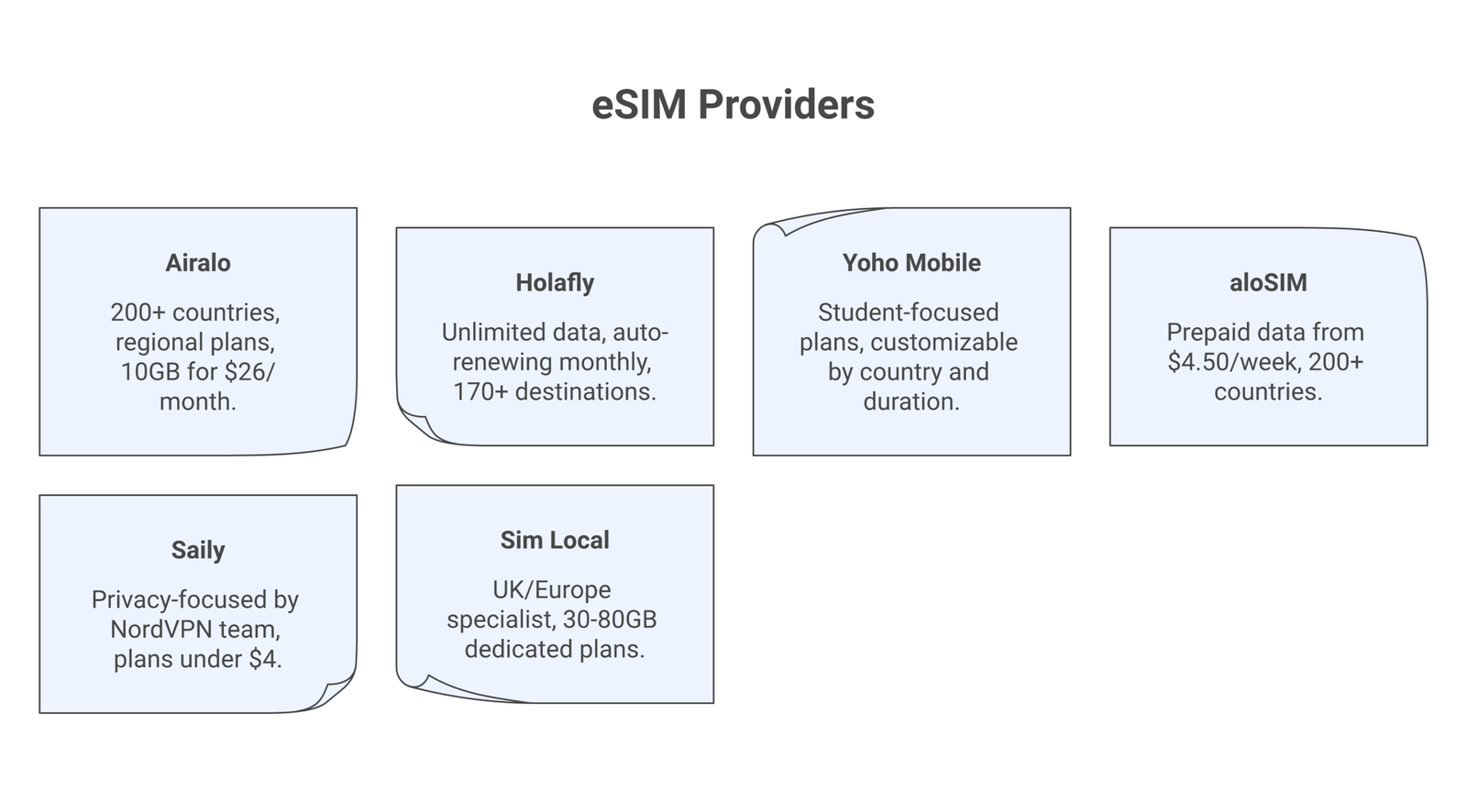
Airalo
Airalo is the largest eSIM marketplace, covering 200+ countries with both local and regional plans. For students, the regional plans are the sweet spot. Their Europe plan offers 10GB for 30 days at around $26, or 20GB for $42. You can top up through the app whenever you run low. Airalo connects you to local carrier networks, so speeds are typically good. The downside is that plans are data-only; you’ll need WhatsApp, FaceTime, or another VoIP app for calls.
Holafly
Holafly offers unlimited data plans, which removes the anxiety of watching your gigabytes tick down. Their monthly subscription covers 170+ destinations, and you can auto-renew so your plan doesn’t lapse mid-semester. The unlimited data is throttled after a fair-use threshold (typically around 20-30GB of high-speed data per day), but for regular use like streaming lectures and video calls, you won’t hit that limit. Pricing runs around $35-55 per month depending on the region.
Yoho Mobile
Yoho Mobile specifically markets to international students and offers customizable plans by country, duration, and data amount. Their “Yoho Care” feature provides backup data if you run out mid-month. Plans are available for the USA, UK, Australia, Canada, and across Europe, making them a good fit for the most common study abroad destinations.
aloSIM
aloSIM covers 200+ countries with prepaid data packages starting from $4.50 per week. They have a useful compatibility checker on their website that tells you whether your specific phone model supports eSIM. Their plans are short-term, which can work if you prefer to buy as you go rather than committing to a monthly subscription.
Saily (by NordVPN)
Built by the team behind NordVPN, Saily focuses on privacy-conscious travelers. Plans start under $4 for basic packages and cover 150+ countries. For students concerned about data privacy on foreign networks, Saily’s built-in connection to NordVPN infrastructure is a real advantage. The app is clean and easy to use, though data allowances tend to be smaller compared to Airalo or Holafly.
How much data do students actually need?
This is the question that trips up most students. You’ll probably use WiFi at your university and dorm for heavy tasks like streaming and downloading lecture recordings. Your eSIM data covers everything in between: commuting, navigating the city, messaging friends, and social media.
Based on typical usage patterns, here’s a rough guide:
- Light use (maps, messaging, email): 3-5GB per month
- Moderate use (social media, occasional video calls): 8-15GB per month
- Heavy use (streaming on mobile, hotspotting your laptop): 20-50GB per month
Most students fall in the moderate range. A 10-15GB monthly plan is enough if you’re disciplined about using WiFi for heavy downloads. If your accommodation doesn’t have reliable WiFi, bump up to 20GB or consider an unlimited data plan.
💡 Pro tip
Download offline maps for your host city before you leave home. Google Maps and Apple Maps both support offline regions. This alone can save 500MB-1GB per month since navigation is one of the biggest data consumers when you’re constantly exploring a new city.
Setting up your eSIM before departure
The best time to set up your eSIM is 1-2 days before your flight. Here’s the process:
1. Confirm your phone is eSIM compatible. Go to Settings > General > About (iPhone) or Settings > Connections > SIM Manager (Android). If you see an option for eSIM, you’re good. The GSMA maintains a compatibility database if you’re unsure.
2. Make sure your phone is unlocked. Carrier-locked phones may not accept third-party eSIM profiles. If you bought your phone on a contract, contact your carrier to request an unlock. In the US, the FCC requires carriers to unlock phones once the contract is fulfilled.
3. Choose a plan that matches your destination. Country-specific plans are cheaper but only work in one country. Regional plans (like “Europe” or “Southeast Asia”) cost more but cover border crossings. If you’ll be traveling between countries during breaks, regional is the better call.
4. Purchase and install the eSIM profile. You’ll receive a QR code via email or in the provider’s app. Scan it with your phone’s camera, follow the prompts, and the profile installs. Don’t activate it yet if your plan starts counting days from activation.
5. Activate when you arrive. Turn on the eSIM profile in your phone settings once you land. Your phone should connect to a local network within a minute or two. Test it by loading a webpage before you leave the airport.
eSIM vs local SIM card for students
Local SIM cards still have a place, but for most students, an eSIM is the better starting point. Here’s why.
A local SIM card gives you a local phone number, which is useful for receiving calls from local businesses, banks, or your university’s admin office. Some countries also require a local number for services like food delivery or ride-hailing. However, getting one usually means visiting a store, providing identification, and possibly waiting days for activation. In countries like Germany and Japan, the paperwork can be surprisingly bureaucratic.
The practical solution for most students is to use both. Keep your home SIM as the primary for calls and texts from family, install an eSIM for affordable local data, and if you discover after a few weeks that you really need a local phone number, visit a shop at your own pace rather than scrambling at the airport on day one.
This dual-SIM approach works on any eSIM-compatible phone. Your phone manages both profiles simultaneously, routing data through the eSIM and calls through your home SIM (or vice versa, depending on your preferences).
Managing data costs on a student budget
Data costs can creep up if you’re not paying attention. A few habits will keep your monthly bill predictable.
Use WiFi whenever it’s available. Your university library, dorm, and most cafes will have free WiFi. Do your streaming, large downloads, and video calls over WiFi and save your eSIM data for when you’re out. According to Statista, the average smartphone user consumes about 19GB per month globally, but most of that happens over WiFi.
Turn off automatic app updates over cellular. Both iOS and Android let you restrict app updates to WiFi only. A single app update can eat 200-500MB.
Disable background app refresh for data-hungry apps. Social media apps like Instagram and TikTok preload content in the background. Turning off background refresh for these apps can save 1-2GB per month.
Monitor your usage weekly. Most eSIM provider apps show real-time data consumption. Check it every Sunday and adjust your habits if you’re burning through data faster than expected. On iPhone, you can also check via Settings > Cellular to see which apps use the most data. Learn more about tracking your eSIM data usage.
Consider a VPN for public WiFi. University networks and cafe WiFi are convenient but not always secure. A VPN like those recommended by the EFF encrypts your traffic and prevents snooping on shared networks. This is especially important when accessing banking apps or entering passwords abroad.
📝 Important note
Some eSIM plans charge extra for hotspot/tethering. If you plan to share your phone’s data connection with your laptop, confirm that tethering is included before purchasing. Holafly, for example, includes tethering on most plans, while some Airalo plans restrict it.
Country-specific tips for popular study abroad destinations
United Kingdom: The UK left the EU’s roaming agreement after Brexit, so European eSIM plans may not cover it. Check specifically for UK inclusion. Providers like Sim Local offer dedicated UK plans with 30-80GB of data. The UK’s Ofcom regulates telecom services, and coverage is excellent in cities but spotty in rural Wales and Scotland.
Germany: Getting a local SIM in Germany requires in-person identity verification (VideoIdent or PostIdent). This makes eSIMs attractive since you skip the bureaucracy entirely. Most European regional eSIM plans include Germany with good LTE and 5G coverage through Deutsche Telekom, Vodafone, and O2 networks.
United States: The US market is dominated by three carriers (T-Mobile, AT&T, Verizon), and coverage varies dramatically by region. T-Mobile offers specific international student plans if you want a local number. Otherwise, an eSIM from Airalo or Holafly using T-Mobile’s network provides solid coverage in cities and suburbs.
Australia: Data prices in Australia are higher than Europe. Budget $30-50 AUD per month for 20-40GB. Telstra has the best rural coverage if you plan to travel outside Melbourne or Sydney.
Japan: Japan has famously fast mobile internet. Most eSIM plans connect through NTT Docomo or SoftBank. The catch is that voice plans are rare for foreign visitors, so you’ll rely on apps for calls. Japan-specific eSIM plans typically range from $15-30 for 10-30GB over 30 days.
South Korea: South Korea has some of the fastest mobile networks in the world, with 5G coverage in all major cities. Student-friendly eSIM plans through providers like Airalo connect via KT or SK Telecom, offering reliable high-speed data. Plans for 30 days start around $20 for 10GB.
Common mistakes to avoid
Activating your eSIM too early. Some plans start the clock the moment you activate, not when you land. If you activate three days before your flight, you’ve already burned three days. Read the fine print about when the validity period begins.
Forgetting to set the eSIM as your data line. After installing an eSIM, you need to tell your phone to route mobile data through it. Go to Settings > Cellular (iPhone) or Settings > Connections > SIM Manager (Android) and set the eSIM as the default data line. Otherwise, your phone will keep using your home SIM’s expensive roaming data.
Not checking coverage maps. “200+ countries” sounds impressive, but coverage quality varies. Before committing, check whether your provider connects through Tier 1 local carriers. Airalo and Holafly show which networks they use in each country.
Ignoring hotspot restrictions. If you’re sharing your phone’s internet with your laptop for studying, make sure your plan allows tethering. Some cheaper plans block it entirely or throttle speeds heavily when hotspotting.
Deleting your eSIM profile accidentally. Once you delete an eSIM profile, you may need to purchase a new one. Most providers won’t reinstall the same QR code. Treat your eSIM profile like a physical SIM: don’t remove it unless you’re switching providers permanently. If you’re unsure about the process, here’s our guide on switching eSIM between phones.
How to stay connected during semester breaks
Semester breaks are when connectivity gets tricky. You might fly home for winter break, take a spring break trip to another country, or travel within your host country. Here’s how to handle each scenario.
Going home for break: Pause your eSIM (if your provider allows it) or let the current plan expire. Reactivate or buy a new plan when you return. Some providers like Holafly with monthly subscriptions let you cancel and resubscribe.
Traveling to another country: If you have a regional eSIM (like a Europe-wide plan), you’re probably already covered. If your plan is country-specific, buy a short-term add-on for your destination. Airalo makes this easy with their app, where you can purchase and activate a new plan within minutes.
Exploring your host country: Your existing plan should work fine. Check data management tips to stretch your allowance if you’re going off the beaten path where WiFi is scarce. Rural areas may have weaker signal, but most eSIM providers connect through the same networks local residents use.
💡 Pro tip
Your phone can store multiple eSIM profiles simultaneously. Install your study-abroad eSIM and keep it even after it expires. When you return for the next semester, you may be able to reactivate it or top it up without going through the setup process again.
What about calls and texts?
Most eSIM plans for travelers are data-only. That means no traditional phone calls or SMS. For the vast majority of students, this is a non-issue. WhatsApp, FaceTime, Zoom, and Telegram handle voice and video calls over data. Your university will communicate via email. Your friends are already messaging you on Instagram or WhatsApp.
The edge cases where you might need a real phone number include:
- Receiving SMS verification codes for banking apps or local services
- Calling emergency services (though most countries allow emergency calls from any SIM)
- Registering for local services that require a domestic phone number
If you keep your home SIM active in the physical slot, you can still receive SMS codes. For local phone numbers, some eSIM providers now offer voice-enabled plans at a premium. Ubigi offers data plus voice packages in select countries, and T-Mobile’s international student plans include calling for US-based students.
Comparing costs: eSIM vs traditional options
Let’s put real numbers on a typical 4-month semester in Europe.
Option A: International roaming from US carrier. AT&T International Day Pass costs $12/day. Over 120 days, that’s $1,440. Even if you only activate it on days you leave your dorm, you’re looking at $600-900 for the semester.
Option B: Local SIM card. A prepaid SIM in most European countries costs $15-25 for the card plus $20-30/month for 10-20GB. Over 4 months: roughly $95-145. Affordable, but limited to one country unless you’re within the EU’s roam-like-at-home regulation.
Option C: eSIM regional plan. Airalo Europe 10GB/30 days at ~$26/month = $104 for the semester. Holafly unlimited at ~$45/month = $180 for the semester. Works across all EU countries plus often the UK and Switzerland.
The eSIM option typically falls between $100-200 for a full semester, making it competitive with local SIM cards and a fraction of the cost of international roaming. Check our detailed eSIM vs roaming cost comparison for more numbers.
⚠️ Disclaimer
Prices and plan details mentioned in this article reflect publicly available information as of March 2026. eSIM providers frequently update their pricing and coverage. Always verify current plans directly on the provider’s website before purchasing.
Frequently asked questions
Yes. Most modern smartphones support dual SIM, where one slot holds a physical SIM and the other is an eSIM. You can keep your home number active on the physical SIM while using the eSIM for local data abroad. Your phone lets you choose which SIM handles calls and which handles data.
What happens if I run out of eSIM data mid-month?Most providers let you buy a top-up through their app. Airalo, aloSIM, and Saily all support instant data top-ups. If your provider doesn’t support top-ups, you can purchase a second eSIM plan and install it alongside your existing one. Your phone can store multiple eSIM profiles.
Do I need WiFi to set up an eSIM?Yes, you need an internet connection to download the eSIM profile. Set it up at home before your flight while you still have WiFi or data. Once installed, the eSIM works independently. You can activate it without WiFi by toggling it on in your phone settings.
Is an eSIM safe to use on foreign networks?eSIMs are as secure as physical SIM cards. The eSIM profile is encrypted and stored in a dedicated chip on your phone. Your data traffic security depends more on the network you’re connected to. For extra protection, use a VPN when connecting to public WiFi networks at universities, cafes, or airports.
Can I transfer my eSIM to a new phone?It depends on the provider. Some eSIM profiles can be transferred through your phone’s built-in transfer tools (iPhone to iPhone via Quick Start, for example). Others require you to contact the provider for a new QR code. In many cases, you’ll need to delete the profile from the old phone and install a fresh one on the new device.
Which eSIM provider is cheapest for a full semester?For a 4-month semester, Airalo typically offers the best price-to-data ratio with regional plans around $25-30 per month for 10GB. If you need unlimited data, Holafly runs about $35-55 monthly. The cheapest option depends on your destination and data needs. Budget 2-3GB per month if you’re a light user or 15-20GB for moderate use.