

eSIM for Turkey: Tourist Guide to Staying Connected
Planning a trip to Turkey and wondering how to stay connected? An eSIM for Turkey gives you instant mobile data the moment you land, no passport registration, no hunting for SIM card shops at Istanbul Airport. Whether you’re exploring Cappadocia’s valleys, navigating the Grand Bazaar, or relaxing on the Aegean coast, having reliable internet access makes everything easier. This guide covers the best eSIM providers, local network coverage, pricing, and setup steps so you can get online in Turkey without overpaying.
📺 Video Guide
Why Use an eSIM in Turkey?
Turkey’s telecommunications market is mature and competitive, with three major carriers providing broad 4G and growing 5G coverage across the country. For tourists, an eSIM is the simplest path to mobile data because it skips two friction points that physical SIM cards create.
First, buying a local Turkish SIM card requires passport registration at a carrier store. Turkcell, Vodafone Türkiye, and Türk Telekom all have airport counters, but queues during peak season can eat 30 to 60 minutes of your arrival time. Second, Turkey’s Information and Communication Technologies Authority (BTK) requires that all phones using local SIM cards be registered through the IMEI system within 120 days, or the device gets blocked. eSIMs purchased through international providers bypass both requirements.
With an eSIM, you buy a plan online before your flight, scan a QR code, and your phone connects to Turkish networks automatically when you land. Your primary SIM stays active for calls and texts from home, while the eSIM handles all your data needs. If you’re new to eSIM technology, our eSIM troubleshooting guide covers the basics of getting connected.
✓ Key benefits of using an eSIM in Turkey
- ✓ Activate before you land, no store visits required
- ✓ No passport registration or IMEI concerns
- ✓ Keep your home SIM active for calls and texts
- ✓ Switch providers instantly if coverage disappoints
- ✓ Typically 60-80% cheaper than international roaming
Turkey’s Mobile Networks: What to Expect
Turkey has three nationwide mobile operators, and the one your eSIM connects to will affect your experience, especially outside major cities.
Turkcell is the largest carrier with the widest rural coverage. According to GSMA data, Turkcell covers over 99% of Turkey’s population with 4G LTE. If you’re heading to eastern Turkey or remote Cappadocia valleys, Turkcell connections tend to hold up better than the alternatives.
Vodafone Türkiye runs a close second for coverage density in urban areas and along the Mediterranean and Aegean coasts. Vodafone’s network performs well in Istanbul, Ankara, Izmir, and Antalya, the cities where most tourists spend their time.
Türk Telekom rounds out the trio. As the legacy state telecom, it has extensive fixed-line infrastructure that supports strong performance in populated areas. Budget eSIM providers often route through Türk Telekom because wholesale rates are competitive.
Some eSIM providers use multi-network agreements, meaning your phone can switch between carriers depending on signal strength. Jetpac and a few others offer this, which is particularly useful if you’re traveling across multiple regions during a single trip. For a deeper comparison of providers, see our best global eSIM providers compared guide.
💡 Pro tip
Check which network your eSIM provider uses before buying. If your itinerary includes remote areas like Mount Ararat, the Lycian Way, or inland Anatolia, prioritize providers that connect to Turkcell for the most reliable signal.
The BTK Restriction: What Travelers Should Know
Since mid-2025, Turkey’s BTK has been actively blocking certain international eSIM providers from operating on Turkish networks. This regulatory crackdown affected over 30 providers, including some well-known names. The telecom industry press reported that the blocks aim to protect domestic carriers’ tourist revenue.
What this means for you: not every eSIM brand that worked in Turkey last year will work now. Before purchasing, verify that the provider explicitly confirms Turkey compatibility for 2026. The providers listed below have been tested and confirmed working as of March 2026.
📝 Important note
If your eSIM stops working after arriving in Turkey, it may have been blocked by BTK. Contact your provider’s support team immediately. Most reputable providers will either fix the issue remotely or issue a refund.
Best eSIM Providers for Turkey in 2026
Based on real traveler testing and community feedback from forums like Rick Steves’ Turkey travel forum, here are the providers that consistently work well for Turkey as of early 2026.
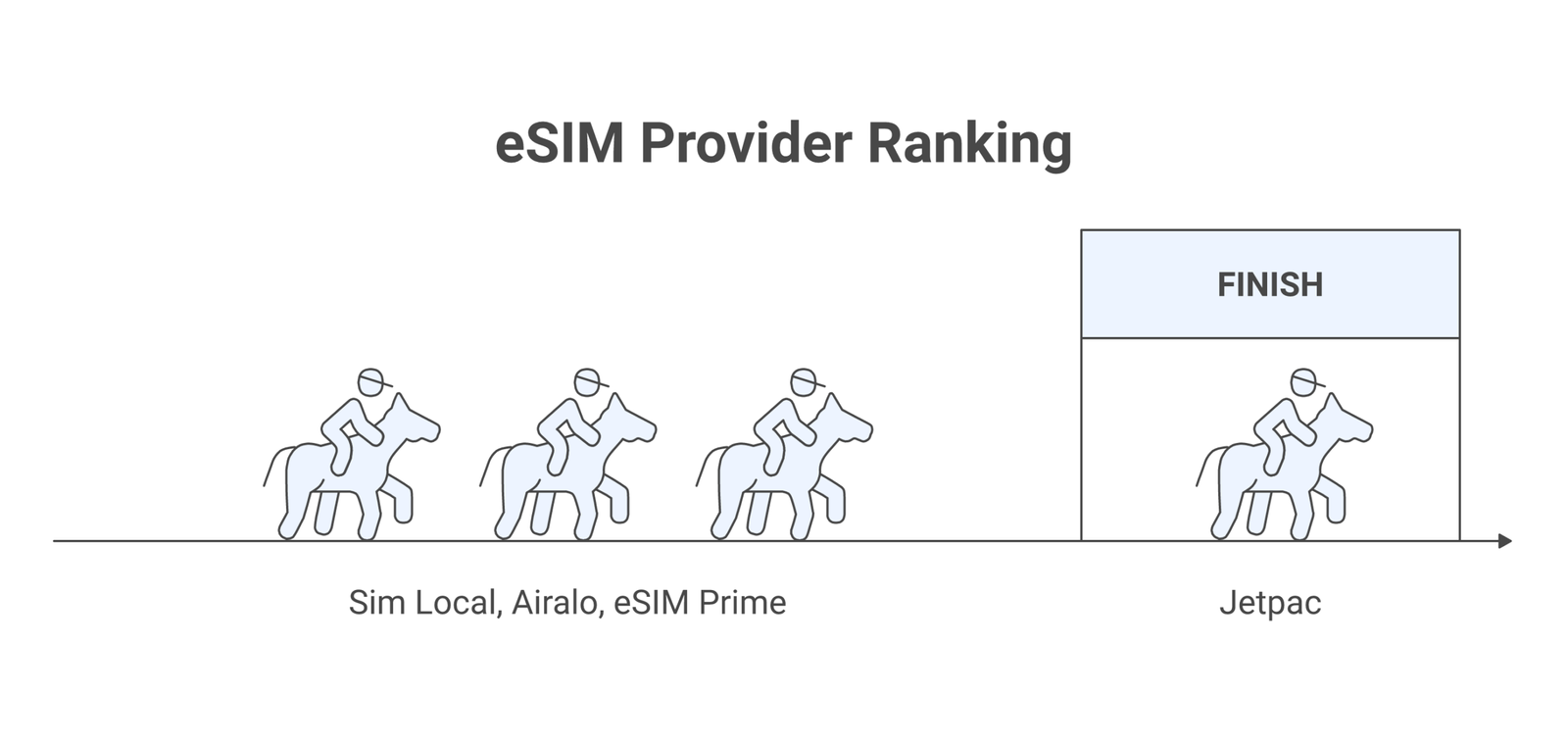
Jetpac
Jetpac offers 30GB for $24 over 30 days, connecting to multiple Turkish networks including Türk Telekom. The multi-network switching is genuinely useful here because Turkey’s geography means signal quality varies significantly between coastal and inland areas. Jetpac is 5G-ready where available and supports hotspot sharing, so you can connect a tablet or laptop through your phone. Setup takes about five minutes through their app, available on both iOS and Android.
Sim Local
For heavy data users, Sim Local provides unlimited data plans starting at $30 for 15 days, going up to $52 for longer trips. They connect primarily through Turkcell, which gives you the strongest overall coverage. Fair usage caps sit around 10GB per day, which is more than enough for navigation, social media, video calls, and moderate streaming. Their 24/7 customer support has gotten positive reviews from travelers who ran into activation issues.
Airalo
Airalo is probably the most recognized name in travel eSIMs. Their Turkey plans start around $5 for 1GB (7 days) and go up to $26 for unlimited data over 7 days. The app is polished and the purchase process is straightforward. However, Airalo has had intermittent issues with BTK blocks, so check recent user reports before buying. When it works, it works well.
eSIM Prime
eSIM Prime has positioned itself as the “BTK-proof” option. They maintain direct carrier agreements that comply with Turkish regulations, meaning their service has remained uninterrupted through the 2025-2026 blocks. They offer plans across Turkcell, Vodafone, and Türk Telekom networks with 4G and 5G speeds. Pricing varies by plan, but the reliability premium is worth it if you need guaranteed connectivity for work or navigation.
Superalink
A budget-friendly choice offering 5GB per day for 7 days at $12 to $17. Superalink connects through Turkcell and Vodafone networks, providing solid coverage in tourist areas. If you’re watching your travel budget and don’t need unlimited data, this is a sensible pick. Check our best budget eSIM providers 2026 roundup for more affordable options.
How to Set Up Your Turkey eSIM
The setup process is nearly identical across providers. Here’s what to do, ideally a day or two before your flight:
1. Check device compatibility. Your phone needs to support eSIM. Most iPhones from the XS onward, Samsung Galaxy S20 and newer, and Google Pixel 3 and later all work. The Apple support page lists all compatible iPhone models. If you’re unsure, dial *#06# on your phone. If it shows an EID number, you’re good.
2. Purchase your plan. Download your chosen provider’s app or visit their website. Select a Turkey plan that matches your trip length and data needs. Pay online and you’ll receive a QR code within minutes, usually by email and in the app.
3. Scan the QR code. On iPhone, go to Settings > Cellular > Add eSIM > Use QR Code. On Android, it’s Settings > Network & Internet > SIMs > Add eSIM. Point your camera at the QR code and follow the prompts.
4. Label and configure. Name the eSIM something obvious like “Turkey Travel” so you don’t confuse it with your primary line. Set it as your data line but keep your home SIM as the default for calls and texts.
5. Enable data roaming on the eSIM line. This step trips up a lot of people. Even though you’re using a “local” eSIM, the phone still treats it as a roaming connection. Go into the eSIM’s cellular settings and toggle data roaming on. At the same time, turn off data roaming on your home SIM to avoid surprise charges.
6. Activate when ready. Some providers activate immediately on scan, while others let you choose when to start your plan. If yours offers deferred activation, wait until you’re at the airport or on the plane before activating, so you maximize your included days.
How Much Data Do You Actually Need in Turkey?
Your data consumption in Turkey depends on what you’re doing. Here’s a rough breakdown based on typical tourist activities:
Light use (1-2GB per day): Google Maps navigation, messaging apps like WhatsApp and Telegram, checking email, posting occasional photos to Instagram. Most sightseeing-focused travelers fall here.
Moderate use (2-5GB per day): All of the above plus video calls, frequent social media use, uploading stories and reels, translating menus with Google Translate’s camera feature, and streaming music.
Heavy use (5GB+ per day): Streaming video, using your phone as a hotspot for a laptop, downloading maps for offline use, remote work with screen sharing. Digital nomads working from Istanbul cafes should plan for this tier.
Most hotels and restaurants in Turkey’s tourist areas offer free WiFi, so you can offload heavy downloads to those connections. The Go Türkiye tourism board lists WiFi availability at major attractions and transportation hubs.
💡 Pro tip
Download offline maps for Turkey in Google Maps before you leave. This saves significant data and works even in areas with poor signal. Cappadocia’s valleys and parts of the Lycian Way have patchy coverage where offline maps become essential.
eSIM Coverage Across Popular Turkish Destinations
Turkey stretches across a massive landmass, and network quality varies by region. Here’s what to expect in the places tourists visit most:
Istanbul: Excellent coverage from all three carriers. You’ll get fast 4G (and increasingly 5G) speeds across the city, from Sultanahmet to Kadıköy, from the Bosphorus ferries to the airport. Data speeds typically hit 30-80 Mbps on 4G.
Cappadocia: Good coverage in Göreme, Ürgüp, and along the main roads. Signal can drop in deep valleys and inside underground cities like Derinkuyu. Turkcell performs best here.
Antalya and the Turkish Riviera: Strong coverage along the entire coast. Resorts and beach areas have reliable 4G. The mountainous terrain behind the coast can create dead spots on secondary roads.
Bodrum and the Aegean coast: Good coverage in town centers and beach areas. Ferry routes between Greek islands and Bodrum may have intermittent signal as you cross into international waters.
Ankara: As the capital, coverage is solid everywhere. You’ll have no issues here.
Pamukkale: Town and travertine terraces have reliable signal. The nearby ancient city of Hierapolis is also well-covered.
Eastern Turkey: Coverage thins significantly past Gaziantep heading east. If you’re visiting Mount Ararat, Lake Van, or Ani ruins, expect gaps. Turkcell has the best reach here, but bring downloaded maps and entertainment as backup.
eSIM vs. Local SIM Card vs. Roaming: Cost Comparison
To put the value of an eSIM into perspective, here’s how the three main connectivity options compare for a typical 10-day Turkey trip:
International roaming from a US or European carrier typically costs $10 to $15 per day. AT&T’s International Day Pass is $12/day, T-Mobile includes some international data but throttles speeds, and Vodafone EU roaming doesn’t include Turkey. For 10 days, you’re looking at $100 to $150.
A local Turkish SIM card from Turkcell costs about €12 for 25GB, which is the cheapest option on paper. But you’ll spend 30 to 60 minutes at the airport store, need your passport, and if your phone isn’t already registered in Turkey’s IMEI system, you face potential complications on longer stays. According to Turkcell’s tourist page, visitor packages are straightforward for short stays.
A travel eSIM costs $13 to $52 depending on data amount and provider. No registration, no wait, instant activation. For the convenience factor alone, the small price premium over a local SIM makes sense for most travelers. Compared to roaming, it’s not even close.
Troubleshooting Common eSIM Issues in Turkey
Even with a good provider, you might hit a few bumps. Here are the most common problems and fixes:
No data connection after landing: The most common cause is data roaming being disabled on the eSIM line. Go to your cellular settings, tap the eSIM line, and make sure data roaming is toggled on. Also confirm the eSIM is set as your active data line.
Slow speeds in tourist areas: During peak hours (late morning to early afternoon), popular areas like Sultanahmet and Göreme can get congested. Try switching to a different network band in your phone’s settings, or wait until off-peak hours. According to Ookla’s Speedtest Global Index, Turkey’s average mobile download speed hovers around 40-50 Mbps.
eSIM suddenly stops working: This could be a BTK block. Contact your provider’s support immediately. If they can’t resolve it, purchase from one of the BTK-compliant providers listed above. Having a backup plan is worth considering if you’re relying on data for navigation or work.
Can’t make local calls: Most travel eSIMs are data-only. They don’t come with a Turkish phone number. Use WhatsApp, FaceTime, or Google Voice for calls over data instead. If you specifically need a local number for booking restaurants or contacting local services, consider a physical SIM card from a Turkcell store.
Tips for Getting the Most from Your Turkey eSIM
Buy before you fly. You can install and configure your eSIM over WiFi at home, so there’s zero fumbling at the airport. Some providers let you delay activation until you’re ready.
Screenshot your QR code. If something goes wrong with the email or app, having the QR code saved in your photos means you can reinstall from another device.
Disable automatic app updates on cellular. A single OS update or large app update can burn through gigabytes. Set both iOS and Android to update only on WiFi.
Use WiFi calling for longer conversations. When connected to hotel or restaurant WiFi, switch to WiFi calling for voice chats instead of burning data.
Monitor your usage. Both iPhone and Android have built-in data usage trackers in Settings > Cellular. Check daily so you don’t run out mid-trip. If you’re running low, most providers allow you to buy additional data through their app, though FCC guidelines on bill shock are worth reading if you’re on a metered plan.
✓ Quick checklist before your Turkey trip
- ✓ Confirm your phone supports eSIM (dial *#06# for EID)
- ✓ Purchase eSIM plan 1-2 days before departure
- ✓ Install eSIM and label it clearly
- ✓ Download offline maps for Turkey in Google Maps
- ✓ Disable auto-updates over cellular data
- ✓ Enable data roaming on the eSIM line after landing
eSIM for Turkey vs. Physical SIM: When to Choose What
An eSIM is the right choice for most tourists visiting Turkey, but there are situations where a physical SIM still makes sense.
Pick an eSIM if: You’re visiting for under 30 days, your phone supports eSIM, you want instant setup, and you don’t need a Turkish phone number. This covers the vast majority of tourist scenarios.
Pick a physical SIM if: You’re staying longer than 30 days and want the cheapest possible rates, you need a Turkish phone number for local bookings or bank verification, or your phone doesn’t support eSIM. Older phones and some Chinese market devices still lack eSIM capability.
Consider both if: You’re a digital nomad staying 2-3 months. Start with an eSIM for immediate connectivity, then grab a local SIM once you’re settled for a cheaper long-term plan. Your phone can run both simultaneously using dual SIM functionality, and our eSIM dual SIM setup guide walks through the process.
⚠️ Disclaimer
Prices and provider availability mentioned in this article reflect information available as of March 2026. eSIM pricing, data allowances, and BTK regulations may change. Always verify current plans and Turkey compatibility directly with your chosen provider before purchasing.
Frequently Asked Questions
No. IMEI registration requirements apply to physical SIM cards purchased in Turkey. International eSIMs bypass this system entirely, making them the more convenient option for short-term visitors.
Can I use my eSIM for WhatsApp calls in Turkey?Yes. WhatsApp, FaceTime, Zoom, and other VoIP services work over eSIM data connections in Turkey. There are no VoIP restrictions in the country, unlike some Middle Eastern destinations.
Will my eSIM work on the ferry between Turkey and Greek islands?Coverage gets spotty once you’re a few kilometers offshore. Your Turkey eSIM may lose signal in international waters and won’t connect to Greek networks (unless your plan includes Greece). Download anything you need before boarding.
How many eSIMs can I install on my phone at once?Most modern phones support 8 or more eSIM profiles, though only one or two can be active simultaneously. This means you can pre-install eSIMs for multiple countries and switch between them as you travel, which is handy for multi-country itineraries that include Turkey.
What happens if my eSIM data runs out mid-trip?Most providers let you purchase additional data through their app. Airalo, Jetpac, and Sim Local all support top-ups. If your provider doesn’t offer top-ups, you can install a second eSIM from a different provider as a backup. Connect to WiFi to purchase and set up the new plan.
Is 5G available for eSIM users in Turkey?Turkey’s 5G rollout is still in early stages as of 2026. Turkcell and Vodafone have 5G in parts of Istanbul and Ankara, but coverage is limited. Most eSIM connections will use 4G LTE, which is fast enough for all typical tourist needs at 30-80 Mbps.