
India eSIM guide for tourists in 2026
An India eSIM is the easiest way to land in Delhi, Mumbai, Goa, or Bangalore with data already working on your phone. You skip the airport SIM queue, keep your main number active for banking or WhatsApp, and start using maps, ride-hailing, and hotel check-in apps the moment the plane door opens. That convenience is why travelers lean on Apple’s guide to using eSIM while traveling internationally and GSMA’s eSIM overview before they fly.
India is huge, busy, and brilliant. You might be bouncing between airport Wi-Fi, intercity trains, mountain towns, and crowded markets in the same week. The official Incredible India portal is a good reminder of how varied those trips can get. Connectivity that feels fine in one city can feel thin in another, so plan choice matters more here than it does on a simple one-country city break.
📺 Video Guide
Why an India eSIM makes sense for tourists
Most tourists only need three things from an India eSIM: reliable 4G or 5G in major cities, simple activation, and enough data for navigation, messaging, and short video uploads. If that sounds obvious, good. That is the point. Travel connectivity should feel boring. When it becomes a daily project, you bought the wrong plan.
The upside is that eSIM support is now normal on recent iPhones and many premium Android phones. Apple’s eSIM setup instructions covers iPhone activation, while the Google Pixel eSIM support page page explains the Android side. If your device supports more than one SIM profile, you can keep your home SIM active for calls and use a travel plan for data only.
For India specifically, I would not overcomplicate this. Buy a plan before departure, install it over Wi-Fi, label it clearly on your phone, and only switch it on when you arrive. If you are continuing across Asia, compare this with our multi-country eSIM guide so you do not buy a country plan when a regional plan would be cheaper.
✓ Why travelers choose an India eSIM
- ✓ No physical SIM swap at the airport
- ✓ Instant access to maps, Uber, and messaging apps
- ✓ You can keep your home line active for OTPs and calls
- ✓ Regional or global plans work well if India is only one stop
How India eSIM plans usually work
Most India eSIM products sold to tourists are data-only plans. You buy a package by country, region, or duration, receive a QR code or in-app install, and connect to a partner network after landing. Marketplaces such as Airalo’s India eSIM plans, Holafly’s India eSIM options, Nomad’s India eSIM plans, and Saily’s India eSIM listing package that process nicely, but the underlying experience still depends on device compatibility and the local carrier partnership.
Local operator support matters too. Pages from Airtel’s eSIM page and the India’s Department of Telecommunications site show how mainstream eSIM support has become inside India itself, even if tourists usually buy through global resellers rather than signing up for a resident-style plan. The practical takeaway is simple: the eSIM technology is mature, but the plan terms still vary a lot. Some plans throttle after a fair-use cap. Others market themselves as unlimited but slow down hard after the first chunk of data.
If your trip is mostly one city plus a beach or mountain extension, a 5 GB to 10 GB plan is often enough. If you plan to tether your laptop, upload short-form video, or spend hours on video calls, read the hotspot policy carefully. That sounds boring until you are in Jaipur trying to send a work deck from your phone.
💡 Pro Tip
Take screenshots of your QR code, APN instructions, and support chat link before you board. If activation hiccups on arrival, you want those details available even before your data starts working.
What coverage is really like for tourists
Coverage in India is a city-first story. In Delhi, Mumbai, Bangalore, Hyderabad, Chennai, Kolkata, and Goa, travelers usually have no trouble getting workable data. The rough edges show up on long train rides, road trips through hill stations, desert routes in Rajasthan, or remote stretches in the Himalayas. That is normal. Even a strong provider can dip outside dense population zones.
When you read provider marketing, filter it through common sense. A claim that an India eSIM has “nationwide coverage” just means it can roam on partner networks across much of the country. It does not mean every village, mountain road, or protected area gets the same experience. That is where checking regional expectations helps, and it is one reason posts like remote area travel advice are useful if your itinerary leans adventurous.
If your route includes multiple countries, also compare the trade-offs in best eSIMs for Southeast Asia and Thailand traveler guide because some Asia plans are easier to manage than buying one new eSIM per border crossing.
How to choose the right India eSIM for your trip
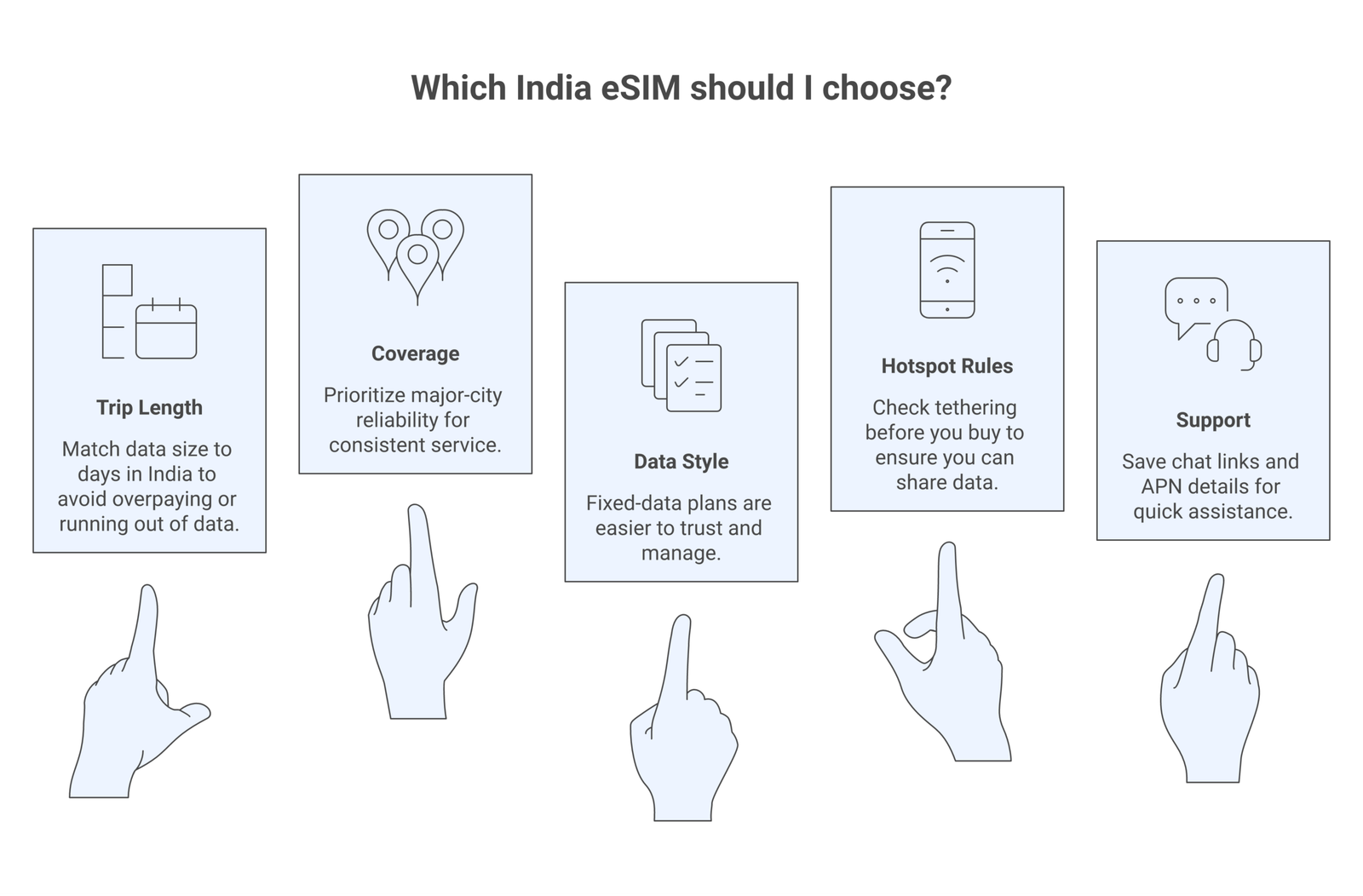
Start with trip length. A four-day business visit and a three-week backpacking route are not the same purchase. Then look at how you actually use data. Heavy Google Maps use, Instagram uploads, and hotspot tethering can burn through a cheap plan fast. Light users who mostly rely on hotel Wi-Fi can get away with a smaller package.
Next, check whether you need only India or a wider regional plan. If you are landing in India and then moving on to Singapore, Thailand, or the UAE, a regional plan may save hassle. If India is your whole trip, country-specific plans are usually better value.
Finally, read the details that people skip: activation window, top-up availability, hotspot allowance, and whether customer support is 24/7. Cheap plans stop being cheap when support disappears the first time the QR code fails.
📝 Important Note
If your phone is carrier-locked at home, the best India eSIM on earth will still fail. Check that your device is unlocked before you pay for any travel plan.
Best plan types for different travelers
Short city break: Buy a small fixed-data plan, usually 3 GB to 5 GB. It is enough for maps, chats, booking apps, and occasional uploads. Longer holiday: Move up to 10 GB or more, especially if you rely on Google Photos, short videos, or hotel Wi-Fi that may or may not behave. Remote worker: Prioritize a provider with clear hotspot rules and easy top-ups. This is where best eSIMs for video calls and streaming and why eSIM often beats roaming help frame the trade-off.
Do not obsess over who claims the absolute fastest speed in a benchmark. For travel, stability matters more. Can you order a cab, join a WhatsApp call, load your boarding pass, and reach your hotel? That is the bar.
Also, be honest about your tolerance for friction. Unlimited-style plans sound reassuring, but many hide fair-use slowdowns. A fixed-data plan with transparent top-up pricing is often the calmer choice.
Setup checklist before you leave home
Install your India eSIM while you still have reliable home Wi-Fi. Follow the steps from Apple’s eSIM setup instructions or the relevant Android support page, but do not switch the plan on early unless your provider says it will only activate on first network connection in India.
Rename the line on your phone to something obvious like “India eSIM”. Set mobile data to use that line, keep your home SIM available for calls if needed, and disable data roaming on the wrong line so your carrier does not surprise you later.
If you are traveling with an iPhone, save the secondary steps from Apple’s guide to using eSIM while traveling internationally. If you are on Android, save the support page and APN instructions in notes or screenshots. It takes two minutes and saves a lot of nonsense at arrivals.
When a local SIM is better than an India eSIM
There are still cases where a physical local SIM wins. If you need a local phone number for longer stays, expect very high data use, or plan to stay in India for months, a resident-style local option can be more flexible. The catch is paperwork, activation time, and the general hassle tourists are usually trying to avoid.
That is why a travel eSIM makes more sense for most short-term visitors. It is faster, cleaner, and good enough for the jobs that actually matter on the road. If you are still deciding between formats, compare this article with eSIM vs pocket WiFi comparison and the older physical SIM comparison logic in your own device setup.
Common India eSIM problems and simple fixes
If your data does not work after landing, do three checks before you panic. First, confirm the eSIM line is turned on and selected for cellular data. Second, check whether roaming needs to be enabled for that line. Third, restart the phone. That boring restart fixes more travel eSIM issues than providers like to admit.
If speeds feel weak, switch from 5G to automatic network selection or LTE and test again. Congestion can be a bigger issue than raw coverage in busy stations, airports, and festivals. If nothing changes, open the provider app or support chat and ask whether the APN should be set manually.
For deeper debugging, read our eSIM troubleshooting guide before you fly. Most failures are setup mistakes, carrier locks, or plan terms the traveler skipped on the checkout page.
⚠️ Disclaimer
This guide is for general travel planning as of April 2026. eSIM availability, partner networks, fair-use limits, and pricing can change quickly. Always confirm the latest plan details on the provider site before you buy.
Bottom line
For most visitors, the best India eSIM is not the one with the flashiest headline. It is the plan that matches your route, your data habits, and your patience level. Buy before departure, keep your setup notes handy, and choose transparency over hype.
If India is one stop on a bigger Asia run, a regional plan may make more sense. If India is the whole trip, a country-specific data plan is usually the cleanest buy. Either way, getting this sorted before the flight is one of those tiny decisions that makes the first day of travel feel much less chaotic.
Frequently Asked Questions
Yes. In fact, that is the best move. Most travel eSIM providers let you buy and install the plan before departure, then activate it when you connect in India.
Does an India eSIM give me a local phone number?Usually no. Most tourist eSIM plans for India are data-only. You can still use WhatsApp, FaceTime, Telegram, and other internet-based apps.
Will an India eSIM work outside major cities?Usually yes, but performance can drop on long train routes, mountain regions, and remote areas. Major cities and tourist hubs are the safest bet.
Can I keep my home SIM active with an India eSIM?Yes, if your phone supports dual SIM or multiple eSIM profiles. Many travelers keep their home line for SMS and use the India eSIM for data.
What if my India eSIM does not connect after landing?Check that the eSIM line is active, make sure roaming is enabled for that line if required, restart the phone, and review APN instructions from the provider.